Making the Rounds in Palliative Care, One Collaboration at a Time
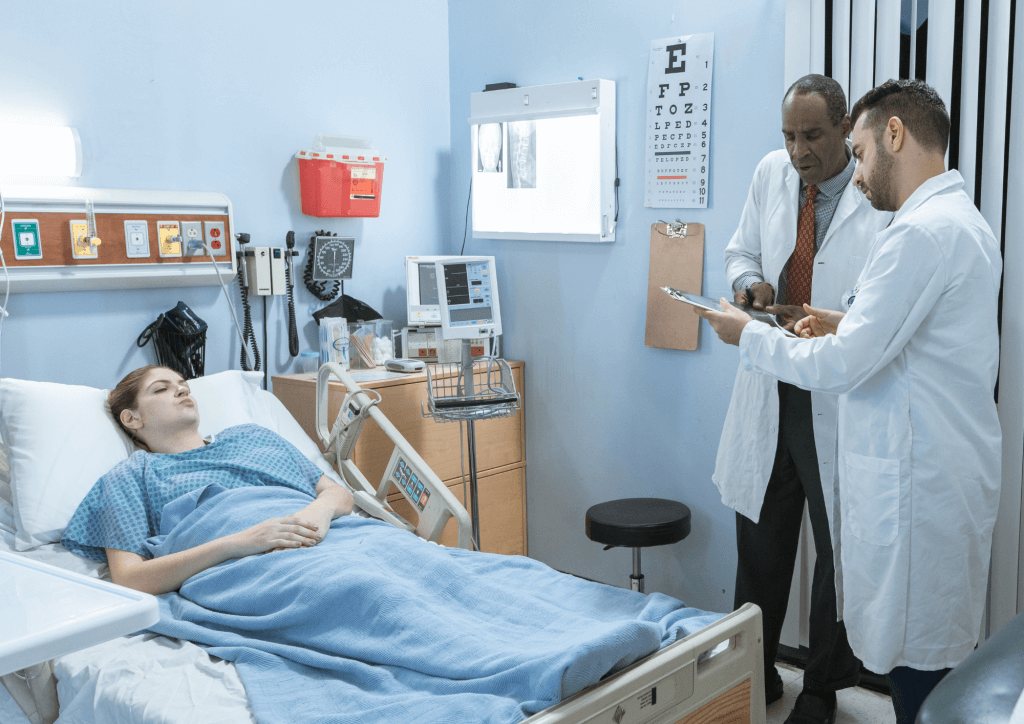
Before it became the norm for trauma units and palliative care physicians to work together, at Vanderbilt University Medical Center (VUMC), Dr. Mohana Karlekar and her colleague, Dr. John Morris, the pioneering head of VUMC’s trauma unit at the time, struck gold when they teamed up in 2007 to discuss how they could collaborate to improve patient care delivery.
One meeting set the tone for a partnership between their departments that has since become a seamless integration of trauma care and palliative care services that has helped shift the treatment protocol paradigm in their respective fields. In this Q & A, Dr. Karlekar shared her thoughts on this, and other collaborations that took shape during informal conversations or meetings and eventually led to initiatives that continue to expand the boundaries of interdisciplinary healthcare.
“…you should just walk around the unit and round with me!”
How did the collaboration between your palliative care department and the trauma unit come about?
When I first came to Vanderbilt University Medical Center, I was asked to meet with providers in any department who either had an interest in or needed palliative care services. When I finally caught up with John Morris, he said, “We need to start using palliative care in trauma.” This was in 2007. John thought that trauma patients could benefit from palliative care because by definition these patients all had serious illnesses. Some had been chronically ill with a complication like a fall. Others were once well but had experienced blunt trauma (i.e. from an MVC, Motor Vehicle Collision). He recognized that surgeons were not traditionally trained to communicate and having a team of clinicians who could help communicate difficult information around diagnosis and prognosis would help to deliver more goal concordant care.
In our first meeting, John began talking about all the ways we (palliative care providers) could be helpful in the trauma area. One day I was in the trauma unit for a consult with him and he said, “In fact, you should just walk around the unit and round with me!” They had at least thirty to thirty-five patients in the trauma bay, ICU and step-down unit at the time.
We went through in real time discussing what types of consults would be helpful or not helpful. It was very collaborative as we went back and forth, “In this case, I think yes, but not that one,” John would say. We decided that the patients who were appropriate for palliative care included ones that created ethical dilemmas (wide awake tetraplegic patients), had a poor prognosis (older adults with falls with a serious injury like traumatic brain injury), one with serious comorbidities who happened to come into trauma (patients with cirrhosis who had an MVC, or patients with traumatic injury with advanced heart failure. There was give and take on who might be involved from both our perspectives so it wouldn’t be stressful on either unit.
What began as, “Let’s get some consults through this robust relationship,” turned into a partnership where we now see a decent number of trauma patients. These days our palliative care trauma consults involve young people with bad brain injuries or older adults who fall, in addition to patients with terminal illnesses. Older adults have a higher incidence of bad traumatic events linked to falls, and it’s really awful to see.
That one conversation years ago led not only to patient care collaboration, but also papers published together and a quality improvement (QI) project focused on the frail and elderly. The project, Creating New Opportunities to Educate Families on the Impact of Frailty and Cognitive Impairment in a Trauma Intensive Care Unit: Results of a Quality Improvement Project, involved teaching nurses to screen for frailty and then consult palliative care for patients with frailty who were admitted to step-down, to discuss goals of care (more long term). I co-authored a book chapter with one of the surgical trauma doctors during COVID. We do yearly lectures for critical care fellows. The trauma team is involved in family meetings and trauma providers partner in palliative care service rotations. Since we started working together, we have always had someone from trauma in family meetings. Now, we work and communicate so well together that if someone from the trauma team can come, great, but they don’t always have to be there.
“We’re going to come up with a project together and this will be our baby.”
Can you talk about other collaborations you’ve been a part of?
Another one that started out as one thing and lead to something else was when I was asked to be a part of a group led by Dr. Gordon Bernard who had been tasked with doing palliative care research. We published COMPASS: A Pilot Trial of an Early Palliative Care Intervention for Patients With End-Stage Liver Disease. One of the group members, Cheryl Gatto, PhD, and I had a couple conversations and found that we were sort of kindred spirits. At the time, we didn’t know each other that well. We started talking one day about something that had happened within the project, and we both agreed that we needed to try to address the issue. From working together on that issue, Cheryl said to me, “Next time, we’re going to come up with a project together and it will be our baby.” I thought, Okay. I don’t know who you are, but you seem like a good person, so I’ll go along with it.
It took about five years, partly because of COVID and other stops and starts. She and I ran this pragmatic trial looking at this surprise question: Would you be surprised if this person died within a year? If the answer was “No, you wouldn’t be surprised by the high likelihood of death,” then you were prompted to do a palliative consultation. That was a trigger through what we used to call BPAs (Best Practice Advisory). Now they’re called CDMs (chronic disease management). The paper, Evaluating Performance of the Surprise Question to Predict 12-Month Mortality in Patients With End-Stage Liver Disease, was published in the American Journal of Hospice and Palliative Medicine. We now have approval to incorporate this CDM into eStar to be used in real time for inpatient clinical practice.
As we began collaborating–I know what my skills are and what my skills aren’t–though I can publish, I’m not a good statistician. So, I mentioned to Cheryl that we do a fellowship research project every year. I asked if she would be interested. She joined the project and for the last two years has been the research point person for which she really has no reason to do. She has a busy job running pragmatic trials with a colleague. She is very passionate about palliative care from personal experience and has been such a wonderful source of information. She picked my brain about certificate courses and ended up completing a certificate course in palliative care, even though she didn’t have to. Now we’ve become really good friends and collaborate on a number of things.
Considering all that she does…Operations Director for the VUMC Center for Learning Healthcare, running clinical trials with the center’s Medical Director, Dr. Matthew Semler…I wondered why she would ask for my help to run a project. She told me, “All you have to do is be the content expert.” That’s the other part of it as well. I told her OKAY but you’ll have to teach me. She sent me all these articles on pragmatic trials. She sent PowerPoints. I read about pragmatic trials, and she read about palliative care. I’m sure she knows more about palliative care than I know about pragmatic trials, but we both learned from each other. Beyond the projects we have our friendship which is the best part.
“A nurse in Zambia needs someone for her PhD mentor group.”
Another sort of accidental collaboration happened because a colleague at the cancer center Dr. Rajiv Agarwal, an oncologist who is a part of our inpatient Palliative Care Consultation service mentioned that a nurse practitioner in Zambia needed someone for her PhD mentor group. I said laughing, “We need to find a way to go to Zambia!” Time passed and I hadn’t heard any more chatter about it. I asked Rajiv for an update. He told me if I was interested, I should reach out to the nurse to find out. Again, recognizing my research skills/limitations, I pulled Cheryl in, and we had a call together with Rajiv and the nurse.
Eventually the nurse sent me the information. They had an NIH SHEPIZ (Strengthening Health Professional Workforce Education Programs for Improved Quality Health care in Zambia) Grant. She said they needed people to come teach in Zambia. I have a friend who by weird coincidence spent a year in Zambia about 25 years ago. She and I went last year and taught for two weeks in Zambia.
We created a certificate program for them. We met local leaders in healthcare and palliative care in Lusaka, Zambia. A year later, we’re rolling out a virtual teaching seminar to keep that going. They joined us as guest faculty for a journal club we did back in January. We talked about opiates and what it’s like to practice pain management in a country where opiates are minimally available. The hope is that this will continue to be an ongoing partnership and that there will be a layering effect where we can touch and connect with more people.
I think when we think about partnerships, (this transcends palliative care and medicine), sometimes asking the question out of curiosity can lead to the unexpected, “What could you do…can you try doing…?” Not being afraid to ask is the key. It would not have happened if I hadn’t said out loud, “Gosh that seems cool!” Sometimes we don’t ask. That was my favorite one [collaboration] and for me, it was very transformative to go there.
“Maybe we should all get together and collaborate.”
Are there any other accidental collaborations you’d like to share?
One more, maybe not so accidental. When I worked in New York city I used to take care of Riker’s patients. The whole top floor of the Bellevue hospital is a Riker’s Prison, a locked unit. I incorrectly thought I knew how to take care of incarcerated patients because I knew the rules there (at Riker’s) and thought I was pretty comfortable with caring for those patients. Fast forward. Two years ago, this patient was handed over to me from one of my partners, who I consider to be very much on top of things and wouldn’t take something at face value if it didn’t make any sense. She told me we have this patient coming in from one of the prisons, but he doesn’t have capacity, so the warden is his decision-maker. It was one of those busy days, so I listened and wrote down everything. I was by myself in the unit that day with a young fellow.
That evening as I was talking to a fellow to give them a hand off, I told her the healthcare decision-maker for the patient is the warden. I stopped in my tracks and said, “That doesn’t make any sense.” The fellow agreed. On my way home I said, “Let me make a call.” I contacted the ethicist. They agreed that the warden should not be the decision-maker. Eventually we tracked down the patient’s wife and I called her. She was surprised and grateful that I’d called her. I was annoyed with myself for taking something at face value at first, but then eventually I got it right. Then I thought this is probably what we all do.
We had one meeting with a group of people to try to figure out the right way to handle this type of situation. I was still upset. My office mate colleague next door does a lot of work with medical students. I explained the situation and gave her information she could disseminate, because the frequency in which we care for these patients is often enough that we know the scenario but not often enough that we’re skilled in what to do. She replied, “We should do an M & M (morbidity and mortality) training about this. Three to four months later we did an M & M for the medical residents to learn about this. We ended up using this topic for the research project for the fellows. That paper has been published in the Journal of Palliative Medicine.
There was a Grand Rounds that my colleague, Dr. Wes Ely did with several people from outside the institution on incarcerated patients, de-shackling. I emailed him and told him that our fellows had sent a poster which got accepted at our academy meeting and that we’re in the process of writing a paper. “Maybe we should all get together and collaborate I said.”
Now we’re working on a collaborative effort to improve the care of patients who are incarcerated. We’re starting with a needs assessment and survey to figure out where people are, then eventually we hope to be able to make some substantive changes. We’ve reached out to nursing leadership who are onboard, ethics, and hospital police. Our division chief, Dr. Tom Elasy, offered to help us create the survey. It started as this annoyance, and I found that other people were annoyed by that same issue, and it’s something people really feel passionate about. It became this small thing that’s catching steam–another example of how collaborations happen unexpectedly.
Dr. Mohana Karlekar is an associate professor of Medicine and Section Chief of Palliative Care at Vanderbilt University Medical Center (VUMC). She helped co-found the Vanderbilt Hospice and Palliative Care Fellowship.
Her areas of interest and expertise include primary palliative care education, the intersection of palliative care and trauma and more recently advancing palliative care in Africa and the care of hospitalized carceral patients. In 2018, she served on the Tennessee Palliative Care and Quality of Life Task Force and has served as chair of the Tennessee state palliative care council since 2019.
 As federal funding priorities shift, researchers may need to pivot to maintain career momentum. Foundation grants can be a key resource, but navigating the process can be tricky. The