Drug Development: What to Expect When Pursuing a Partnership with Industry

Doing Research / Networking & Collaboration

David Merryman and his research group’s work in targeted drug strategies has led to multiple forays into industry collaboration and company development.

He admits that the path to drug development has been more nuanced than expected as he continues to work towards his ultimate goal of advancing a new drug into the clinical setting.

Reflecting on his experiences, he candidly shared his observations on navigating industry partnerships and starting a biotechnology (biotech) company.


How did your partnership with one of the largest pharmaceutical companies in the world materialize?

Merryman: I have two collaborators, both named Craig. Craig Lindsley is a medicinal chemist and pharmacologist. He runs the Warren Center for Neuroscience Drug Discovery. His group focuses on drug design. Craig Duvall works in biomedical engineering. He develops carrier-free RNA drugs. My lab identifies the mechanism and the need. They work to design the new drug or new delivery method. In collaborating with their labs, we’ve filed patents around new chemistry to deliver drugs.

Craig Duvall and I formed an industry partnership with Bayer in Germany to develop a drug for kidney disease as part of their kidney disease drug development program. The partnership dissolved prematurely when Bayer shifted away from that program towards developing biomarkers and clinical studies as the company faced increased litigation surrounding its acquisition of the Monsanto corporation, the manufacturer of the weed killer Round-Up. After a year, Bayer returned the patent it had licensed from Vanderbilt and ended the partnership.

After that, Craig Lindsley and I collaborated in making a new drug. Following a few failed attempts at partnering with various companies, we launched SERO Pharmaceuticals, a clinical-stage biotechnology company, which is about a year old. We’re trying to raise money to do IND (Investigational New Drug)-enabling studies and get to a clinical trial. For a couple of years, Craig and I were primarily looking to partner with a drug company. We didn’t want to start a company, but we ended up starting one anyway. One benefit is that we have agency over what we choose to focus on.


Would you share some takeaways based on your experiences?

Merryman: In academic medicine, discovery of new applications for existing drugs, or gaining a deeper understanding of disease progression, is important, but what’s more valuable to investors is having patentable materials, novel chemistry, or novel compounds that are patented.

Projects that are further along in development are more attractive to investors, as are ones that demonstrate knowledge of the toxicology features of a drug (whether the drug can make people sick). Surprisingly, in previous pitches, even with strong preclinical data based on animal models demonstrating a drug worked on the disease, a lot of the big companies told us to come back after we had human data. Once you get past a phase 1 clinical trial, lots of companies become interested, but it might cost around $10 million to do the trial. That’s a heavy lift.

Investors are also interested in the development of biomarkers. In a lot of drug development processes, investors either want a specific drug mutation that they can hone in on and they know exactly how it works, or they want biomarkers in the phase 1 trial that will give them confidence that a very expensive phase 2 trial will most likely work.

We had to be overly prepared for a fair amount of scrutiny from potential investors. There were lots of questions. Sometimes we were questioned about our knowledge of other projects that only the senior members of the companies we were pitching to had knowledge of. Companies could be vetting multiple projects simultaneously or evaluating their competition. The information we provided seemed disproportionate to how much feedback we received after being rejected. To move past the disappointments, it’s always been important for me to stay focused on my desire to develop drug therapies that can improve the lives of patients.

Preparing for the long game is helpful. You’ll kiss a lot of frogs. However, it’s also important to keep in mind that patents have a 17-year lifespan. You need to accelerate through the development process to get to your Investigational New Drug (IND) studies. And you have to factor in a minimum of two years for clinical trials, if they go splendidly fast. Companies that invest heavily in new drugs want at least ten years of protected patents where only they can sell those drugs.

Final thoughts?

Merryman: I’ve seen drugs succeed commercially that weren’t the best drug, but the scientist was savvy in lining up multiple investors. Networking and building relationships with potential investors and people in industry are important.


David Merryman, PhD, is the Walters Family Professor and Associate Chair for the Department of Biomedical Engineering. His research examines the role of mechanical forces in altering cardiovascular, pulmonary, and renal cell function at the gene, phenotype, and protein levels, with particular focus on the serotonin 2B receptor and cadherin-11.

Handling AI Hallucinations in Biomedical Science

Doing Research

In its scariest “feature,” AI can sometimes hallucinate or present false propositions as truth. Sometimes, those claims are ridiculous, but other times, they can seem quite truthful. We’ve heard about stories of lawyers submitting court briefs with false citations and want to avoid egg on our faces, too. What are some helpful practices to avoid that?

We have to accept AI’s limitations, three of which stand out. First, we have to accept that AI is inherently probabilistic. That is, because it doesn’t know what’s 100% accurate, it plays the probabilities and will always be wrong some of the time. Much like crowdsourcing research, it is not perfect. Therefore, it needs our fact-checking.

Second, we have to accept how AI “knows” things. It has no ability to fact-check claims in reality. Instead, it takes in training data and, based on those data, tries to predict a how to respond. It’s not a scientist interested in foundational truths. As with other authorities, we scientists have a responsibility to question authorities to see whether they align with our facts.

Finally, hallucinations often occur the deeper you get into a session, for yet-unknown reasons. The more you communicate with AI in a given instance, the more likely it will spit out a counterfactual remark.

But all hope is not lost! AI is actually pretty good at checking itself. Researchers call this self-evaluation feature “AI as judge.” If you copy-and-paste an entire session into another AI instance and ask it to check itself for accuracy, it’s pretty good at finding its errors. Thus, it can act like sensitive and specific tests in biomedicine. Any test on its own is often not perfectly sensitive and specific. However, when combined, the tests’ probabilities make for a strong combination. Even then, they might not be perfect (strongly sensitive and strongly specific tests still produce false positives), but the results together are weighty. Similar percentages are at play with AI.

A less expensive technique is to ask AI to explain its reasoning (i.e., tell it to “show your work”). This technique helps us fact-check its references and become better scientists and thinkers ourselves. The AI bot can explain its reasoning behind a decision based on its evidence. If that evidence seems dubious, then the conclusions should be rejected.

Even so, the danger remains of accepting evidence that “sounds right” even if it’s not right. That’s why we’re responsible for our own work. It’s a reminder why AI will never be able to replace good, scientific work that’s based on understanding the universe’s truths. AI cannot reality-test items; only we can. At present, it merely accepts anything that it’s read in its training data, and we all know how many falsehoods exist in this large, diverse world.

Like human mistakes, hallucinations seem to be with us. Our minds cannot go to sleep when an AI bot points us to some conclusion. Nonetheless, we can take steps to minimize those mistakes, often using AI itself. The responsibility of fact-checking remains ours, though, especially as scientists who the public relies on to grasp truth. No AI, under current models, can achieve that trust.

Making the Rounds In Palliative Care, One Collaboration at a Time

Doing Research / Networking & Collaboration

Making the Rounds in Palliative Care, One Collaboration at a Time


Before it became the norm for trauma units and palliative care physicians to work together, at Vanderbilt University Medical Center (VUMC), Dr. Mohana Karlekar and her colleague, Dr. John Morris, the pioneering head of  VUMC’s trauma unit at the time, struck gold when they teamed up in 2007 to discuss how they could collaborate to improve patient care delivery.

One meeting set the tone for a partnership between their departments that has since become a seamless integration of trauma care and palliative care services that has helped shift the treatment protocol paradigm in their respective fields. In this Q & A, Dr. Karlekar shared her thoughts on this, and other collaborations that took shape during informal conversations or meetings and eventually led to initiatives that continue to expand the boundaries of interdisciplinary healthcare.

“…you should just walk around the unit and round with me!”

How did the collaboration between your palliative care department and the trauma unit come about?

When I first came to Vanderbilt University Medical Center, I was asked to meet with providers in any department who either had an interest in or needed palliative care services. When I finally caught up with John Morris, he said, “We need to start using palliative care in trauma.” This was in 2007. John thought that trauma patients could benefit from palliative care because by definition these patients all had serious illnesses. Some had been chronically ill with a complication like a fall. Others were once well but had experienced blunt trauma (i.e. from an MVC, Motor Vehicle Collision). He recognized that surgeons were not traditionally trained to communicate and having a team of clinicians who could help communicate difficult information around diagnosis and prognosis would help to deliver more goal concordant care.

In our first meeting, John began talking about all the ways we (palliative care providers) could be helpful in the trauma area. One day I was in the trauma unit for a consult with him and he said, “In fact, you should just walk around the unit and round with me!” They had at least thirty to thirty-five patients in the trauma bay, ICU and step-down unit at the time.

We went through in real time discussing what types of consults would be helpful or not helpful. It was very collaborative as we went back and forth, “In this case, I think yes, but not that one,” John would say. We decided that the patients who were appropriate for palliative care included ones that created ethical dilemmas (wide awake tetraplegic patients), had a poor prognosis (older adults with falls with a serious injury like traumatic brain injury), one with serious comorbidities who happened to come into trauma (patients with cirrhosis who had an MVC, or patients with traumatic injury with advanced heart failure. There was give and take on who might be involved from both our perspectives so it wouldn’t be stressful on either unit.

What began as, “Let’s get some consults through this robust relationship,” turned into a partnership where we now see a decent number of trauma patients. These days our palliative care trauma consults involve young people with bad brain injuries or older adults who fall, in addition to patients with terminal illnesses. Older adults have a higher incidence of bad traumatic events linked to falls, and it’s really awful to see.

That one conversation years ago led not only to patient care collaboration, but also papers published together and a quality improvement (QI) project focused on the frail and elderly. The project, Creating New Opportunities to Educate Families on the Impact of Frailty and Cognitive Impairment in a Trauma Intensive Care Unit: Results of a Quality Improvement Project, involved teaching nurses to screen for frailty and then consult palliative care for patients with frailty who were admitted to step-down, to discuss goals of care (more long term). I co-authored a book chapter with one of the surgical trauma doctors during COVID. We do yearly lectures for critical care fellows. The trauma team is involved in family meetings and trauma providers partner in palliative care service rotations. Since we started working together, we have always had someone from trauma in family meetings. Now, we work and communicate so well together that if someone from the trauma team can come, great, but they don’t always have to be there.


“We’re going to come up with a project together and this will be our baby.”

Can you talk about other collaborations you’ve been a part of?

Another one that started out as one thing and lead to something else was when I was asked to be a part of a group led by Dr. Gordon Bernard who had been tasked with doing palliative care research. We published COMPASS: A Pilot Trial of an Early Palliative Care Intervention for Patients With End-Stage Liver Disease. One of the group members, Cheryl Gatto, PhD, and I had a couple conversations and found that we were sort of kindred spirits. At the time, we didn’t know each other that well. We started talking one day about something that had happened within the project, and we both agreed that we needed to try to address the issue. From working together on that issue, Cheryl said to me, “Next time, we’re going to come up with a project together and it will be our baby.” I thought, Okay. I don’t know who you are, but you seem like a good person, so I’ll go along with it.

It took about five years, partly because of COVID and other stops and starts. She and I ran this pragmatic trial looking at this surprise question: Would you be surprised if this person died within a year? If the answer was “No, you wouldn’t be surprised by the high likelihood of death,” then you were prompted to do a palliative consultation. That was a trigger through what we used to call BPAs (Best Practice Advisory). Now they’re called CDMs (chronic disease management). The paper, Evaluating Performance of the Surprise Question to Predict 12-Month Mortality in Patients With End-Stage Liver Disease, was published in the American Journal of Hospice and Palliative Medicine. We now have approval to incorporate this CDM into eStar to be used in real time for inpatient clinical practice.

As we began collaborating–I know what my skills are and what my skills aren’t–though I can publish, I’m not a good statistician. So, I mentioned to Cheryl that we do a fellowship research project every year. I asked if she would be interested. She joined the project and for the last two years has been the research point person for which she really has no reason to do. She has a busy job running pragmatic trials with a colleague. She is very passionate about palliative care from personal experience and has been such a wonderful source of information. She picked my brain about certificate courses and ended up completing a certificate course in palliative care, even though she didn’t have to. Now we’ve become really good friends and collaborate on a number of things.

Considering all that she does…Operations Director for the VUMC Center for Learning Healthcare, running clinical trials with the center’s Medical Director, Dr. Matthew SemlerI wondered why she would ask for my help to run a project. She told me, “All you have to do is be the content expert.” That’s the other part of it as well. I told her OKAY but you’ll have to teach me. She sent me all these articles on pragmatic trials. She sent PowerPoints. I read about pragmatic trials, and she read about palliative care. I’m sure she knows more about palliative care than I know about pragmatic trials, but we both learned from each other. Beyond the projects we have our friendship which is the best part.


“A nurse in Zambia needs someone for her PhD mentor group.”

Another sort of accidental collaboration happened because a colleague at the cancer center Dr. Rajiv Agarwal, an oncologist who is a part of our inpatient Palliative Care Consultation service mentioned that a nurse practitioner in Zambia needed someone for her PhD mentor group. I said laughing, “We need to find a way to go to Zambia!” Time passed and I hadn’t heard any more chatter about it. I asked Rajiv for an update. He told me if I was interested, I should reach out to the nurse to find out. Again, recognizing my research skills/limitations, I pulled Cheryl in, and we had a call together with Rajiv and the nurse.

Eventually the nurse sent me the information. They had an NIH SHEPIZ (Strengthening Health Professional Workforce Education Programs for Improved Quality Health care in Zambia) Grant. She said they needed people to come teach in Zambia. I have a friend who by weird coincidence spent a year in Zambia about 25 years ago. She and I went last year and taught for two weeks in Zambia.

We created a certificate program for them. We met local leaders in healthcare and palliative care in Lusaka, Zambia. A year later, we’re rolling out a virtual teaching seminar to keep that going. They joined us as guest faculty for a journal club we did back in January. We talked about opiates and what it’s like to practice pain management in a country where opiates are minimally available. The hope is that this will continue to be an ongoing partnership and that there will be a layering effect where we can touch and connect with more people.

I think when we think about partnerships, (this transcends palliative care and medicine), sometimes asking the question out of curiosity can lead to the unexpected, “What could you do…can you try doing…?” Not being afraid to ask is the key. It would not have happened if I hadn’t said out loud, “Gosh that seems cool!” Sometimes we don’t ask. That was my favorite one [collaboration] and for me, it was very transformative to go there.


“Maybe we should all get together and collaborate.”

Are there any other accidental collaborations you’d like to share?

One more, maybe not so accidental. When I worked in New York city I used to take care of Riker’s patients. The whole top floor of the Bellevue hospital is a Riker’s Prison, a locked unit. I incorrectly thought I knew how to take care of incarcerated patients because I knew the rules there (at Riker’s) and thought I was pretty comfortable with caring for those patients. Fast forward. Two years ago, this patient was handed over to me from one of my partners, who I consider to be very much on top of things and wouldn’t take something at face value if it didn’t make any sense. She told me we have this patient coming in from one of the prisons, but he doesn’t have capacity, so the warden is his decision-maker. It was one of those busy days, so I listened and wrote down everything. I was by myself in the unit that day with a young fellow.

That evening as I was talking to a fellow to give them a hand off, I told her the healthcare decision-maker for the patient is the warden. I stopped in my tracks and said, “That doesn’t make any sense.” The fellow agreed. On my way home I said, “Let me make a call.” I contacted the ethicist. They agreed that the warden should not be the decision-maker. Eventually we tracked down the patient’s wife and I called her. She was surprised and grateful that I’d called her. I was annoyed with myself for taking something at face value at first, but then eventually I got it right. Then I thought this is probably what we all do.

We had one meeting with a group of people to try to figure out the right way to handle this type of situation. I was still upset. My office mate colleague next door does a lot of work with medical students. I explained the situation and gave her information she could disseminate, because the frequency in which we care for these patients is often enough that we know the scenario but not often enough that we’re skilled in what to do. She replied, “We should do an M & M (morbidity and mortality) training about this. Three to four months later we did an M & M for the medical residents to learn about this. We ended up using this topic for the research project for the fellows. That paper has been published in the Journal of Palliative Medicine.

There was a Grand Rounds that my colleague, Dr. Wes Ely did with several people from outside the institution on incarcerated patients, de-shackling. I emailed him and told him that our fellows had sent a poster which got accepted at our academy meeting and that we’re in the process of writing a paper. “Maybe we should all get together and collaborate I said.”

Now we’re working on a collaborative effort to improve the care of patients who are incarcerated. We’re starting with a needs assessment and survey to figure out where people are, then eventually we hope to be able to make some substantive changes. We’ve reached out to nursing leadership who are onboard, ethics, and hospital police. Our division chief, Dr. Tom Elasy, offered to help us create the survey. It started as this annoyance, and I found that other people were annoyed by that same issue, and it’s something people really feel passionate about. It became this small thing that’s catching steam–another example of how collaborations happen unexpectedly.


Dr. Mohana Karlekar is an associate professor of Medicine and Section Chief of Palliative Care at Vanderbilt University Medical Center (VUMC). She helped co-found the Vanderbilt Hospice and Palliative Care Fellowship.

Her areas of interest and expertise include primary palliative care education, the intersection of palliative care and trauma and more recently advancing palliative care in Africa and the care of hospitalized carceral patients. In 2018, she served on the Tennessee Palliative Care and Quality of Life Task Force and has served as chair of the Tennessee state palliative care council since 2019.


Vanderbilt Medicine was Built to Unite Clinics and Labs and to Inspire a Country

Book Reviews / Doing Research / Faculty Life

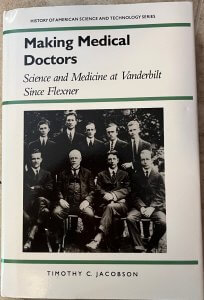
It often helps to look at history to understand the present. Vanderbilt Medical Center has a storied history, and fortunately, a few books preserve that story for the present. Timothy Jacobson’s Making Medical Doctors: Science and Medicine at Vanderbilt Since Flexner tells the story of Vanderbilt’s medical school since an important date. Although this book is about forty years old (and still available), it’s one of the most accessible records of the medical center’s founding. I’ll share some of that story here.

The title provokes the question: What exactly happened with Flexner? Even though the Flexner Report is over 100 years old, many working in medicine remain familiar with its name. Published in 1910, this report ultimately revolutionized the way the United States pursued medical education. It sought to make medical education follow the German model, then-recently pioneered in the US at Johns Hopkins. When implemented, it shut down many smaller medical schools that could not pursue scientific research, sadly including many schools focused on underserved populations. Instead, it recentered medical education around laboratory-based medicine, which it still is today. Thus far, this story is commonly shared.

Not as famous is the story of Vanderbilt’s central role in testing Abraham Flexner’s views. When the Flexner Report came out, many immediately doubted whether American medical education could adapt. They admired Johns Hopkins’ and the Germans’ work but questioned whether the entire nation could implement it. The report was too revolutionary for a grand scale, they said. In response, Flexner needed a test case to prove his ideas could apply broadly and looked for a good one for the next 15 years. He ultimately focused on a project to re-found Vanderbilt’s medical school, then an unnoteworthy institution in a stagnated region.

In 1925, Vanderbilt University was a private school focused on public service in the reconstructed South. Sixty years after the Civil War, the South was still recovering economically from war’s upheavals, and despite its initial endowment by tycoon Cornelius Vanderbilt, Vanderbilt tended to lag other Northern schools in quality. Without a standard-bearer for the new paradigm, medicine all over the South ran behind the times.

Vanderbilt Chancellor James Kirkland, Abraham Flexner, and Dean of Medicine G. Canby Robinson conspired to reboot the medical school into something much grander than had been previously run. It has operated since 1874 without much distinction, and the best Flexner could report was that it had “satisfactory laboratories” in many fields. However, it was enough for the visionary Kirkland to court Flexner to bring a new format. The three made an unusual group for the project: Kirkland was an ambitious Latin professor, Flexner an educator with no formal healthcare expertise, and only Robinson had a physician’s education at Johns Hopkins.

In 1925, Vanderbilt Medical School was re-founded to test Flexner’s ideas about a laboratory-based education. Before this date, the medical school did not stand out significantly from other Southern medical schools. However, Flexner, working with the Rockefeller Foundation’s General Education Board from 1912-1928, secured unique funding for Vanderbilt. At the time, large federal healthcare funding was not available, and no other institution received as big a largess from the Rockefeller family’s riches. With a religious penchant for good social deeds, the Rockefellers used their immense wealth from Standard Oil to advance noble ends across America all the way to Nashville.

Vanderbilt hired aggressively but wisely. The renewed Vanderbilt Medical School sought to integrate research and medical training intimately and attract nation-leading faculty to implement this new vision. Fortunately, dedicated scientific luminaries like Ernest Goodpasture signed up for the grand experiment. Vanderbilt capitalized on the spirit of the age in that, like Johns Hopkins and its German forebears, it integrated the clinic and the lab intimately. Unlike these others, it did so in a region that was not as economically vibrant – an impressive feat to reconstruct a still-divided nation. It proved that with proper funding and leadership, a successful, research-driven medical school was possible anywhere. The Flexner Report’s ambitions were proven feasible even in the recovering South. Eventually, they were implemented nationwide.

(For more information about the Flexner Report’s broader impact on American medicine, I recommend the treatment in The Social Transformation of American Medicine by Paul Starr (1982) on pages 116-127. The book won a Pulitzer Prize in 1984 and is a gem to understand the American medical system’s history. Another treatment is available at Duffy TP. The Flexner Report–100 years later. Yale J Biol Med. 2011 Sep;84(3):269-76. PMID: 21966046; PMCID: PMC3178858.)

Then truly innovative, attendings, students, and residents could roam freely between labs and clinics at Vanderbilt in an almost seamless manner. Goodpasture provides a good example of its value. As a pathologist, he famously invented a way to mass produce viral material in egg yolks. This was a key step to mass producing viral material to disseminate vaccines to the wider population. By integrating the clinical question of supplying vaccines with a laboratory method, he demonstrated the value of close-knit relationships between the clinic and the lab. Not many other places in the world could have produced such an innovation.

Before an era of big government grants, these scientists spent their days quietly bringing the lab to patients and patient care into lab work. Using luminaries like Johns Hopkins’ William Osler as a launch pad, they showed that science could broadly meet society’s needs for medical care, starting in Nashville.

After World War II, many medical centers grew along Vanderbilt’s model with increased federal biomedical research funding. Unlike other centers, however, Vanderbilt’s administration deliberately aimed to keep alive the dream of major research advances. Many institutions used federal funds to provide jobs for regional facilities; as Jacobson details, Vanderbilt sought to maintain its initial vision of integrating labs and the clinics in novel ways. Its identity remains, in no small part, to integrate and translate research and clinical advancements.

Jacobson’s book details many more ebbs and flows of Vanderbilt’s journey until the book’s publication in 1987. With stories like these, he illustrates that education, research, and service served as historic foundations still directing its course. Since its re-founding, Vanderbilt never intended to be merely another medical center, but instead to lead healthcare projects from bench to bedside and back way before that catchphrase was ever dreamed of. Its students impacted the entire southern region with a curious, scientific approach to medical care. This history can guide our biomedical community to continue to imagine big for the nation’s and world’s patient care today.

Making Medical Doctors: Science and Medicine at Vanderbilt Since Flexner
By Timothy C. Jacobson
Copyright © 1987
The University of Alabama Press
ISBN13 9780817303150
Page Count: 349

Faster, Better Chart Abstraction with Brim

Manual chart abstraction of unstructured data has created big bottlenecks in medical research – data doesn’t help researchers if it’s trapped in electronic notes. New software from Vanderbilt, Brim, makes chart abstraction up to 80% faster and often more accurate as well by leveraging AI. So far, it’s been used for drug repurposing, oncology clinical trials, genetics testing, emergency general surgery, pickleball injuries, and many more projects.

Brim is currently free for Vanderbilt faculty, staff, students, and postdocs; use this request form to get started. Those outside of Vanderbilt should request a demo to learn more about using Brim at their institution. Brim prioritizes data security, providing a fully containerized deployment and allowing you to Bring Your Own LLM (BYO LLM), so you can use your institution’s preferred, secure LLM with Brim running on top of it. This creates privacy and protection of health information.

Once you have access to Brim, the process is simple and designed for non-technical users:

  1. Import patient records from a simple CSV (which can be downloaded via SD Discover, Epic Clarity, or other EHR connectors).
  2. Define the data you want abstracted. You can do this in a fully manual way, or leverage the tool to generate and optimize draft variables and dependent variables.
  3. Use Brim to generate abstracted data points, covering hundreds of charts in minutes.
  4. Give feedback on these data points so Brim can optimize the variables until you reach the desired accuracy. Each data point is linked to evidence from the original text so you can check for hallucinations or false interpretations.
  5. When you’re satisfied with the extraction, export the data as a CSV file for further analysis.
Brim is managed by Dr. Fabbri in the Department of Biomedical Informatics at VUMC. The project has received support from ARPA-H. Brim is currently under active development, and feedback on the interface and desired functionality/features is very welcome!

Having Difficult Conversations

Communication / Doing Research / Management & Leadership / Mentoring

No matter how in tune you are with your colleagues, at some point, you’ll find yourself in conflict and needing to have a difficult conversation. In my leadership roles at VUMC and elsewhere, I’ve had plenty. Here are some strategies for making these conversations less stressful and coming out with a win for all sides.

First, what is a difficult conversation? Of course, it’s anything hard to talk about. Self-esteem of one or both parties is often at risk, and important issues are at stake. Often, when you’re having a difficult conversation, you care deeply about the other person or people. These conversations can center on a host of issues that may involve misunderstandings, assumptions, a clash of values, or a perception of unfair treatment. Some examples in science include:

  • A postdoc skips regular meetings with the group leader. The leader lets it slide, and then the postdoc attempts to publish on their own.
  • Authorship order and inclusion is not established early.
  • Trainee projects and roles aren’t clearly defined, leading to conflict instead of cooperation.
  • Someone in the lab isn’t doing their fair share of work.

When an issue like this arises, you have a few choices for responding. You can remain silent—but silence can take an emotional toll, and the issue can simmer until it explosively erupts. You can respond immediately—but then your response may become confrontational and/or unproductive. Or you can respond later, giving yourself time to think, but there is some risk with waiting too long.

Take a deep breath. Ask yourself these questions:

  • What is the importance of the issue and the relationship?
  • How does it make you and the other person feel?
  • What does this say about me and my identity?
  • What do I really want?
  • What do I want for others?
  • What do I want for this relationship?
  • Is this something I can possibly resolve with the other party, or will we need help?
  • What are the options?

Each difficult conversation is really three separate conversations: 1) What happened? 2) How does it make the people involved feel? 3) What does this say about our identities?

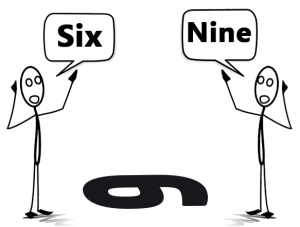
“What happened” is often a matter of perspective. Consider the picture to the right. Just because the person who thinks the number is a six is correct doesn’t mean the person who thinks it’s a nine is wrong. Both have their own perspectives. Assigning blame early is rarely productive.


Many people are reluctant to talk about feelings at work, but avoiding any discussion of how an incident made you feel can cause you to miss some important underpinnings of the conflict. How each party feels has implications for their identities. If someone is concerned about being perceived as a bad person, it’s hard to have a productive conversation.

Curiosity helps immensely in these situations. Try to set aside your preconceptions and learn more about the situation. Some things you might say:

  • Tell me more about…
  • My point of view is different. Can you help me understand…?
  • Help me understand your intent when you said/did…
  • What were you feeling when…?
  • Let’s figure this out together

Listen to learn, not just to respond. Bring empathy and grace for yourself as well as the other party. Acknowledge that impact often does not equal intention (and vice versa).

Here’s an example of this process in action: Imagine you are a radiologist like me. You’re performing an ultrasound on a pregnant person and a medical student is with you. You can’t find the fetal heartbeat, and the mom, knowing something is wrong, starts to cry. The medical student rushes from the room.

You could assume the student is uncaring about their patients. You could even say this to the student. But if you listen to learn, you might instead say, “I noticed you left when the patient started crying. Can you help me understand what was going on?” And you might learn that the student had a miscarriage three weeks ago. The initial assumption no longer makes much sense.

Stay curious and aim for the most respectful interpretation of others’ behavior. Let that curiosity lead you in these interactions and frame these conversations.


I am a certified Leadership and Performance Coach and have mentored and coached over 130 physicians and other individuals. Having a curious and open mindset is essential to coaching. I have published multiple peer-reviewed papers and have given national invited presentations on mentorship and coaching. My mission is to help physicians, scientists, and other individuals achieve personal and professional growth and fulfillment. Please feel free to reach out to me at Lori.deitte@vumc.org if you are interested in learning more.

Some of the information in this post comes from Crucial Conversations by Joseph Grenny, Kerry Patterson, Ron McMillan, Al Switzler, and Emily Gregory, and Difficult Conversations by Douglas Stone, Bruce Patton, and Sheila Heen. Check them out for more tips and strategies to make these kinds of conversations go well.

Rekindling the Fire: A Review of The Joy of Science

Book Reviews / Doing Research / Faculty Life

For most of us, science begins with a rush of “Wow! This is super cool!” But the emotional fire can subside after years of hard work. Negativity in popular culture can make us forget the depths of our why. To rekindle our passion to see the universe’s beauty, physicist Roel Snieder and policy expert Jen Scheider remind us of the human heart of science and lay out a spiritual center to our enterprise.

By highlighting our personal role in discovery, they provide a template for scientists seeking to both live a fulfilling life and do first-rate science. This template offers seven principles that can enrich our lives under the hypothesis that happy people produce better work. These principles are harmony, courage, vision, curiosity, listening, compassion, and integrity.

Each chapter doesn’t merely provide a “rah rah” pick-me-up; it cites the literature and analyzes the subject in a manner appropriate for scientists. The authors study scientists’ spirits, how each of us feel as we work, and present these feelings as noble expressions of human spirit. Playful, hand-drawn illustrations excite the imagination as the authors practice what they preach – and bring readers along for the ride. Sections also provide practical exercises for readers to integrate these abstract concepts into their day-to-day lives.

One of my takeaways: Modern conversation often puts spirituality and science at odds with each other. Religions, the traditional home of spirituality, sometimes tread on science’s turf, and scientists sometimes fear the untested authority of religion. In my own life, I’ve found that science and religion have a lot to learn from each other, and both can benefit from more listening, a core principle in this book. This text does not address religion directly, but the authors do describe what human spirituality in scientific endeavors looks like from two scientists’ perspectives. They speak of science not as a chore to complete nor as a grade to earn but as a “love” to explore. In academe, it’s easy to neglect such intrinsic emotional engagement with our work.

By giving us examples of how personal attitudes interact with scientific endeavors, the authors explain these seven principles’ impact in concrete terms. For instance, they help us relate our science to our students and even our children. They also extrapolate what inner courage resembles in a scientific career. Elsewhere, they dwell on staving off a sense of professional loneliness and having compassion for students who can also be lonely in their work. To them, finding joy in your work translates into bringing joy to the rest of the world through your work.

Snieder and Scheider contend that honing personal qualities can reduce the chore of getting work done while encouraging us to skip to work each day. As with most things, increased happiness requires attentive effort but is ultimately realizable. Paying attention to our innate human spirituality can bring personal meaning to ourselves and help us convey nature’s wonder better to others. This book shows us how. It reminds us that life’s beauty isn’t found just in exotic natural oases; with the right attitudes, it’s found at our lab benches as we investigate, in our scientific journals as we read, and on our fingertips as we type.

The Joy of Science

Reframing Rejection: Changing ‘No’ to ‘Not Yet”

Doing Research / Faculty Life

Current Application Status: Not Discussed

“Thank you for submitting your work to our Journal. It has been carefully reviewed by experts in the field and we regret to inform you that we must REJECT your manuscript.”

We’ve all been there, many times. Sometimes it can feel like the life of a scientist is one rejection after another. It can be defeating, demoralizing, and demotivating. I’ve been at this for a while now, and over time I have come to view “rejection” in a completely different way. It was really my roles as an Associate (and now Deputy) Editor at The American Journal of Physiology – Lung Cellular and Molecular Physiology and as a standing study section member for the NHLBI K08/K01 Awards (plus a little wisdom of old age) that fundamentally changed my view of “rejection”. Here are a few things I’ve learned:

  1. Peer reviewers are just like you and me. It’s true. I know it often feels like reviewers are ogres salivating at the chance to destroy your hard work (read: the dreaded Reviewer #2). This is just not true. You know who the reviewers are? You and me. Maybe you’re just starting out in your career and you haven’t had a lot of experience as a manuscript or grant reviewer. Trust me, you will. When I receive a paper at AJP-Lung or a grant for study section, I’m excited to see what it’s all about. After all, we got into science because it is exciting, cool and fun. I feel a sense of ownership of the grant/paper and I want to do right by it. I know that I am not unique in these sentiments and that (many?) other reviewers feel exactly the same way. You will too when you get there.
  2. Peer review makes the science better. Also true. Don’t believe me? Take a moment to pull out that first version of your grant, the one that was “Not Discussed,” and read it. It might be good, or not, but it is almost certainly not as good as the second (or third…or fourth…) version. Like me, you might actually be grateful that it did not get funded on that first go around. Each version of a grant or paper is better than the previous because peer reviewers (see #1) have read it and given you great suggestions. Peer reviewers often bring up new ideas, make you think of an experiment that you hadn’t considered, uncover unexpected conclusions. All in all, your work is better because of peer review.
  3. Our job is not as unique as we think. A few years ago, I was as an elementary school party talking to a parent of my son’s friend. This dad is a hotel developer. He buys old historic buildings and turns them into chic boutique hotels. I thought this sounded interesting, so I asked him to tell me a bit more about it. He relayed that his team of a few people find a building they are interested in and work for a few weeks or months to put together a proposal for the project. They then submit the proposal for review by the developers. Guess what? He said about one in five of his proposals actually gets selected. Put another way, 4/5 are REJECTED! Sound familiar? This encounter put my job (which I always thought was totally unique) in perspective. To me, being a scientist is like being an entrepreneur. We have lots of ideas. Some are good, others are not so great, and we look to our colleagues to help us move forward with the best.

With these ideas in mind, I’ve developed some tricks to help reframe “rejection” in my mind. Here they are:

  1. Read the reviews as if they are coming from your mentor. We are extremely grateful when our mentor takes the time to critically review our work and offer criticisms and suggestions. Read grant and manuscript reviews to yourself in your mentor’s voice and it will take away some of the sting.
  2. Put yourself in the reviewer’s place. Think of a time when you noted a major hole or weakness in something you were reviewing. You had to make pointed comments, but think of your mindset. I’m guessing you were truly trying to make the work better. The people reviewing your work are doing the same thing.
  3. View peer review as an integral part of the scientific process. This is key. Peer review, and its inevitable rejection, is not a barrier put in your way just to make you struggle miserably. Rather, it is an integral part of the scientific process that we scientists have established. In our lab meetings, we pore over data, picking it apart, looking for holes, making it better. Peer review serves this function on a larger scale.
  4. Get to know some people outside of science. Talk to people outside of science and I guarantee you will start to see parallels. Ask a songwriter if every song was a hit (I live in Music City after all!), have an investment banker tell you about their successes and failures, invite a teacher to tell you about a lesson plan gone horribly wrong. As scientists, we are privileged to have an uncommon and interesting job, but our struggles are not unique; they are just a little different.

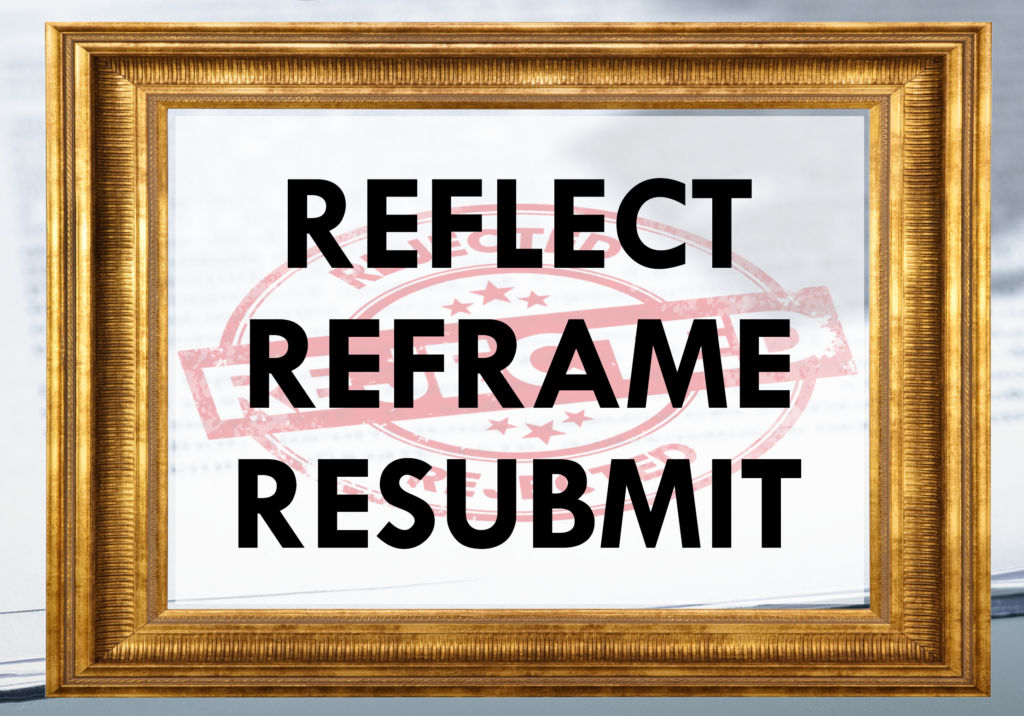
So next time you receive a disappointing “reject” decision, take a moment to reflect, reframe, and resubmit.

Additional Resources

Not that Kind of Letter: Tales of Rejection
Honing Resiliency: Reminders from a Recent Disappointment
Growing Stronger in the Face of Rejection: Roundup

Awesome Things About Life in Research

Doing Research / Faculty Life / Trainees

Building a list of awesome things that come with life in research, one quirky, funny, inspiring piece at a time. Missing your favorite awesomeness? Or have The perfect image? Add in comments or tweet @edgeforscholars to share your personal twist on why science rocks. #JoyOfScience

142. Having your NIH Program Officer say, “I am cautiously optimistic about funding your application.”

141. Meeting new incredibly smart people

140. My hypothesis was right

139. p<.05

138. The code runs with no errors!

137. When you actually learn something new

136. Getting to hear about others knowledge

135. Implementing evidence-based practice

134. Collaborating with amazing students who then become amazing friends

133. Seeing your mentees present at the Translational Research Forum

132. My RN6 colleagues/friends

131. Groundbreaking results

130. When your hypothesis was right

129. Learning the coolest stuff first

128. Developing new research ideas from clinical observations

127. Near peer mentoring

126. Training the next generation

125. Adding a new study site

124. Making new collaborations

123. Vortex machines

122. Talking to smart people all the time

121. Mentoring

120. Watching students & trainees develop & succeed

119. Assays (like ELISA’s) that change color

118. Working with smart trainees

117. Traveling the world in the name of science

116. Building a research team

115. Being on the cutting edge of discovery

114. Seeing the innovation of new researchers

113. The excitement of new findings

112. When the code has no bugs

111. When the data definitively disproves your hypothesis in a new and interesting way

110. Being surrounded by amazing minds

109. Watching participants grow up & change

108. Solving interesting problems with smart people

107. Putting complex data into human communication

106. Understanding the complex web of factors affecting the outcome

105. Answering the big question and getting answers

104. Spending my life’s work pursuing something other than the bottom line in a society that is solely obsessed with the bottom line what’s more punk than publicly funded science?

103. Having your NIH Program Officer say, “I am cautiously optimistic about funding your application”

102. Coming up with crazy ideas with my friends and then actually getting them funded!

101. Making a difference for people and advancing care/improving outcomes

100. Vortexing

99. Working with trainees/students

98. Travel!!

97. I get paid to read and think about cool stuff

96. I’m my own boss

95. Pipetting is fun

94. Things change color

93. Holiday gift baskets in the break room

92. Lab holiday spirit

91. Funny tweets from serious scientists

90. Uploading grades at the end of the course

89. Discussing a new project with a person who challenges the way I think

88. Embracing the unpredictable

87. Having the exact number of pipette tips left that you need

86. Using lasers as light sabers

85. Mice don’t page you at 3 AM

84. Flexible time

83. Mother Nature telling you a secret before anyone else

82. Community that comes to the rescue

81. Dry ice in Eppendorf tubes

80. Collaborations

79. It is the most rewarding job

78. Having the whole lab to yourself

77. Hearing patient perspectives

76. Getting paid to ask ‘why?’

75. New & immediately useful info in journal club

74. End of a semester

73. Start of a semester

72. Having lab animals in my life

71. Reward for being ADHD

70. Chairs who go to bat for faculty

69. NIH supplements

68. Congratulations from a distant colleague

Spontaneous science nerd discussions over lunch.

67. Spontaneous science nerd discussions over lunch

66. JIT requests

65. Media coverage that gets it right

64. Perfectionist biostatisticians

63. Travel funds

62. Color coding OCD is normal

61. Upgrade of computing power

60. Invitation to serve on grant review panel

59. Seeing the twinkle of understanding in a student’s eyes

58. (Safe) lab pranks…dry ice in eppendorf tube under you labmate’s chair

57. Genuine breakthroughs

56. Your own brand-new lab equipment

55. Your first student’s first publication

54. Desk copies of textbooks

53. Cures

52. Labs that believe in parties

51. Reviewing an amazing and well-written paper

50. Academic kindness

49. Upbeat program officers

48. New knock out/in created in record time

Cat-o-meter via @icedarkroast47. Science communication

46. Science advocacy

45. Congratulations on your science received in public

44. New data visualization tools

43. Playing with the infrared thermometer.

42. Catching up with old lab buddies at meetings.

41. Coming home inspired.

40. Going to scientific meetings.

39. Fellow post docs starting their own labs.

38. Science & umbrella drinks (aka destination conferences)

37. Anticipation before settling down to analyze data set. Christmas for adults!

36. Minor revisions to resubmit

35. Gorgeous results from immunofluorescence assays

34. Finding your ‘invisible’ splinter under the microscope

33. Getting to draw on the windows

32. Dunkin Donuts naming scientists #1 consumers of coffee

31. Cold room on a sweltering day

30. Celebration stickers for lab notebooks when folks crush their experiments

29. Fact that scientists actively rebel against meetings

28. Dancing and pipetting with headphones

27. Seeing science in everything

26. Joys of liquid nitrogen and latex gloves

25. Being in charge of my own schedule (and not just because I don’t have an assistant).

24. Celebrating null findings

23. Finishing the last analysis for a paper

22. NOGAs

21. A tweet about your recently published paper

20. Running with slides

19. On time participant who holds their breath for their MRI

18. Permission to ask incessant questions

17. Curing cancer in mice

16. Mass spec works for seven days straight

15. Big donor (where are these?)

14. Grant funding

13. Confirming the drug binds the target in humans

12. Drying my shoes in a dessicator

11. Creating science fiction tools in real life

10. Statistical significance

9. Unlimited access to dry ice

8. Free lunch/dinners with strangers (aka applicants)

7. Working outside in the sunshine

6. Isoflurane contact high

5. Quoting your favorite science tweeps

4. The fume hood is free

3. Seeing the microscopic world

2. The model converges

1. Zillion uses for Parafil

Leading a Lab: Compass Program for Leadership and Management Training

Doing Research

This fall I had the opportunity to participate in Compass (Wash U Compass: Elevating Biomed Professionals (researchercompass.org)), a leadership and management training and mentoring program for early career researchers. An NIH-funded program led by a team at Washington University School of Medicine in St. Louis, Missouri, Compass is open to all biomedical junior faculty and postdocs in the United States for FREE! The program “trains individuals to lead and manage successful teams, navigate career challenges, and balance life and science by providing mentoring, practical tools, and other resources.” It is a fully remote program, which makes it easy to fit into your schedule, and I found it incredibly helpful. The program runs multiple times a year and applications are accepted on a rolling basis.

Compass provides a TON of information and resources. Here are just a few key highlights I found especially helpful:

  1. Learning Content. The Compass program is divided into three units: Leading Others, Managing Scientific Work, and Leading Self. The team has put together incredible Coursebooks for each unit that share a wealth of information on topics such as cultivating a positive work environment, building relationships, giving and receiving feedback, resolving conflict, hiring and managing team members, setting boundaries, and managing wellness. There are also several videos throughout the learning platform that highlight some of the best practices found within the Coursebook material. The learning platform is sleek and easy to use.
  2. Expert Advice. In addition to the main content shared throughout the course, expert mentors are invited to share their experiences through short videos, case studies, and live events. It was nice to hear from successful lab leaders on what has (and hasn’t) worked for them as they’ve developed their careers.
  3. Putting it into Practice. One unique aspect of this program is the ability to practice new skills and receive feedback. There are several opportunities to video yourself responding to situations you might encounter in your career where you can get instant feedback via an Auto Analysis tool. Though a bit uncomfortable, it was great practice! Additionally, the main “deliverable” of the program is to complete a Lab Manual. This assignment, which you work on over the entire course, really gets you thinking about how you would like your lab to operate. There are multiple chances throughout the course to receive written and oral feedback on the manual.
  4. Peer Mentoring. Another fantastic aspect of Compass is the ability to connect with peers. This is partially done through topic discussion boards in the learning platform, but the most helpful, in my opinion, is meeting regularly with a peer mentoring team. My peer mentoring team clicked really well, and we enjoyed seeing each other each week. Some of the weeks had guided activities, some we worked on or discussed Lab Manuals, and others we bounced ideas off each other and helped each other work through challenges. We found our meetings to be so helpful that we have decided to continue meeting monthly.

I would highly recommend this program to anyone leading or planning to lead a research group. The course is geared more toward the academic track, but the skills learned would be valuable to any biomedical scientist leading a lab.

For more information or to submit an application, visit the Compass website at Wash U Compass: Elevating Biomed Professionals (researchercompass.org).