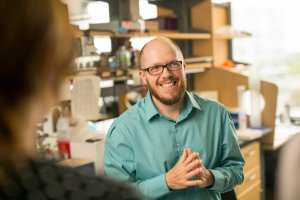
David Merryman and his research group’s work in targeted drug strategies has led to multiple forays into industry collaboration and company development.
He admits that the path to drug development has been more nuanced than expected as he continues to work towards his ultimate goal of advancing a new drug into the clinical setting.
Reflecting on his experiences, he candidly shared his observations on navigating industry partnerships and starting a biotechnology (biotech) company.
How did your partnership with one of the largest pharmaceutical companies in the world materialize?
Merryman: I have two collaborators, both named Craig. Craig Lindsley is a medicinal chemist and pharmacologist. He runs the Warren Center for Neuroscience Drug Discovery. His group focuses on drug design. Craig Duvall works in biomedical engineering. He develops carrier-free RNA drugs. My lab identifies the mechanism and the need. They work to design the new drug or new delivery method. In collaborating with their labs, we’ve filed patents around new chemistry to deliver drugs.
Craig Duvall and I formed an industry partnership with Bayer in Germany to develop a drug for kidney disease as part of their kidney disease drug development program. The partnership dissolved prematurely when Bayer shifted away from that program towards developing biomarkers and clinical studies as the company faced increased litigation surrounding its acquisition of the Monsanto corporation, the manufacturer of the weed killer Round-Up. After a year, Bayer returned the patent it had licensed from Vanderbilt and ended the partnership.
After that, Craig Lindsley and I collaborated in making a new drug. Following a few failed attempts at partnering with various companies, we launched SERO Pharmaceuticals, a clinical-stage biotechnology company, which is about a year old. We’re trying to raise money to do IND (Investigational New Drug)-enabling studies and get to a clinical trial. For a couple of years, Craig and I were primarily looking to partner with a drug company. We didn’t want to start a company, but we ended up starting one anyway. One benefit is that we have agency over what we choose to focus on.
Would you share some takeaways based on your experiences?
Merryman: In academic medicine, discovery of new applications for existing drugs, or gaining a deeper understanding of disease progression, is important, but what’s more valuable to investors is having patentable materials, novel chemistry, or novel compounds that are patented.
Projects that are further along in development are more attractive to investors, as are ones that demonstrate knowledge of the toxicology features of a drug (whether the drug can make people sick). Surprisingly, in previous pitches, even with strong preclinical data based on animal models demonstrating a drug worked on the disease, a lot of the big companies told us to come back after we had human data. Once you get past a phase 1 clinical trial, lots of companies become interested, but it might cost around $10 million to do the trial. That’s a heavy lift.
Investors are also interested in the development of biomarkers. In a lot of drug development processes, investors either want a specific drug mutation that they can hone in on and they know exactly how it works, or they want biomarkers in the phase 1 trial that will give them confidence that a very expensive phase 2 trial will most likely work.
We had to be overly prepared for a fair amount of scrutiny from potential investors. There were lots of questions. Sometimes we were questioned about our knowledge of other projects that only the senior members of the companies we were pitching to had knowledge of. Companies could be vetting multiple projects simultaneously or evaluating their competition. The information we provided seemed disproportionate to how much feedback we received after being rejected. To move past the disappointments, it’s always been important for me to stay focused on my desire to develop drug therapies that can improve the lives of patients.
Preparing for the long game is helpful. You’ll kiss a lot of frogs. However, it’s also important to keep in mind that patents have a 17-year lifespan. You need to accelerate through the development process to get to your Investigational New Drug (IND) studies. And you have to factor in a minimum of two years for clinical trials, if they go splendidly fast. Companies that invest heavily in new drugs want at least ten years of protected patents where only they can sell those drugs.
Final thoughts?
Merryman: I’ve seen drugs succeed commercially that weren’t the best drug, but the scientist was savvy in lining up multiple investors. Networking and building relationships with potential investors and people in industry are important.
David Merryman, PhD, is the Walters Family Professor and Associate Chair for the Department of Biomedical Engineering. His research examines the role of mechanical forces in altering cardiovascular, pulmonary, and renal cell function at the gene, phenotype, and protein levels, with particular focus on the serotonin 2B receptor and cadherin-11.
