Advice for (New) Assistant Professors Extravaganza

Doing Research / Faculty Life

Originally posted in #MHAWS: Mirya Holman’s Aggressive Winning Scholars Newsletter.

Hello darlings!

Welcome to the annual “Mirya Holman gives some advice to (new) assistant professors” extravaganza! MHGSATNAPE just rolls off the tongue, right?

Here’s the advice I gave last year about starting as an assistant professor in the middle of a pandemic. A lot of it still applies! Read it if you want!

Updated advice: What I wish I knew 10+ years ago.

Remember: Mirya Holman is not for the faint of heart. If all this advice doesn’t work for you – congrats, you are normal. Take what might work and move on. Or listen to none of it. I don’t give a shit. But maybe MHAWS is really absolutely super your fucking jam? Then go get yourself some MHAWS merch!


Five rules that I wish I had known: 1) be a good social scientist and collect and organize data; 2) Borrow, beg, steal, but don’t reinvent the wheel; 3) Self-care is never selfish; 4) Make your own damn rules; & 5) be kind to yourself and others. Do you want a little note that features this advice? Download it here!

How the fuck are you supposed to do all this while learning how to be a professor… a job that feels like an Olympic sport and one that graduate school does not train you for one fucking bit?!!? Keep reading my lovelies for some tricks and tips:

Rule 1: Collect and organize data. That means: asking a lot of questions, observing social patterns, figuring out the written and unwritten rules. It also means figuring out who you can trust and who can be vulnerable with – both are SO important. Collect data on where the money is, where the course buy-outs are, how new classes work, what is the schedule of things. It means document the bad shit. It means knowing yourself. So: here’s what I would do:

  • Keeping track of deadlines: Anytime any important date comes up, put it on your calendar. This could be internal grant deadlines or when grades are due or when you have to apply for a 3rd year leave (if that exists). Is this a yearly deadline? Make it a repeated reminder every year.
  • Collect data on who should be in your coven: Peer connections are the fucking bomb.com. Scope the situation at faculty orientation – who are the other people who seem like they won’t be assholes? (Or the right kind of assholes. Find your kind of assholes!) Make lunch or dinner or drink dates with other junior faculty in your department if they exist. If you meet someone cool at a university event, send them an email the next day and invite them to lunch or coffee. Make connections.
  • Find mentors who will tell you all the important bits of data: This is tough. Sometimes you will get a mentor and it will be a perfect fit and the birds will sing (this happened to me! At Tulane! Shout out to Celeste Lay who is an amazing mentor. I’m super lucky.). But sometimes this most definitely won’t happen. So be entrepreneurial. Ask lots of people the same kinds of questions and see what answers you get. Turns out, professors LOVE giving people advice (helllloooo, I write a newsletter of this shit), so there will be LOTS of advice and some of it will be absolute shit. If someone gives you really good advice, go back to them. If someone gives you bad advice, DON’T TELL THEM. Instead, hide a cracked can of tuna fish in their ceiling tiles right before they go away for a month. Just joking. Kind of.
  • Document everything. If you have a meeting with your chair where they promise you repeat preps for your first three years, follow up with an email that says “confirming the details of our meeting” with the exact details. If a student is being weird, send an email to someone about it. ANYTIME anything is weird – sexual harassment, racist shit, sexist shit, DOCUMENT IT to a neutral third party. Easy way to do this is to send yourself an email with the details, especially who, what, where, and when information like day, time, witnesses, exact shit that happened. Is someone regularly an asshole to other people in the department? They are an asshole! Document that shit! It took me a long time to realize how correct Maya Angelou was when she said, “When people show you who they are the first time believe them.” So keep a list! (personally, I have a little black book entitled “People I want to punch in the face.” Go here to get yourself one.)
  • Code the data the right way from the beginning: Do it right from the start. Find out if you will have an annual or semi annual review and ask for a copy of the template. Even better – ask someone in your department if they wouldn’t mind sharing one of their past ones so you can see it filled out. Put your shit in that template as soon as you do it. You know what? You are not going to remember in Dec 2020 that in March 2020, you attended a brunch with incoming students. But if you put it down, then you don’t have to remember!  Ask what kinds of documents you will need for tenure and promotion – will you need hard copies of book chapters? Conference papers? What should your CV look like? (Mine had to be in chronological order. What asshole decided that?) If you start off collecting and coding your information the right way, you can save time and energy in the long run.

Rule 2: Don’t reinvent the wheel. Don’t act like you are the first person to teach a class or try to submit an article. Don’t you dare think you are the first person to ever think that department meetings are the dumbest shit on the face of the planet. Don’t think that you are the only person who has ever felt depressed and lonely in our jobs. Don’t believe that you are the only one in academia, in your discipline, in your department who has been harassed or discriminated against. That’s what the man wants. Don’t give it to him.

  • Ask for help from other people who have done what you are doing. DO NOT come up with a syllabus from scratch. Trust me, in the 10000000 times that someone’s taught Congress, there haven’t been 10000000 unique approaches. Or probably 1000 unique approaches.
  • Ask for help from other people (I’m putting it twice it is so important). Like really. Did you know that I’ll send you my syllabi, slides, and assignments from any class I’ve taught? I will! Just ask! Other people will as well! Did you know if you tweet out help for an assignment on XYZ, people will just respond to you with their assignments? SERIOUSLY. ASK FOR HELP. Did you know that there are entire journals on how to teach? FOR REALSY. Maybe not all of the stuff you get will work for you, but that day that you slept like shit and you forgot about a meeting and you have 15 minutes to prep for class – that lecture or activity is going to be FUCKING GOLDEN.
  • Ask for help from people in your department. This is harder. None of us want to seem like we are dumbasses in front of our colleagues. I’ve found that flattery is the best way to get assistance, but to still look like you know what you are doing. “I noticed that you have a lot of students working for you. That’s so awesome. Would you mind walking me through the process of hiring a student? You are clearly the expert here!” There’s also a ‘question window’ for your first couple of months where everyone assumes that you are just trying to figure out how stuff works. (But if you’ve worked at my university for 20 years and you try to get someone else to fill out a fucking form for you because ‘you don’t know how to do it’, I WILL LOSE MY SHIT. True story.). Also, if you are nice to the office staff, they will answer your questions for you. ALWAYS BE NICE TO STAFF.
  • Ask for help from people on campus who are paid (really!) to help you. Go to all the orientations and afterwards, type up your notes about anything that was important. Ask HR questions about benefits. Figure out your retirement asap and start paying as much as you can into it as soon as you can (some places require that you be “vested” for some period before they match. Put that vesting date on your calendar and make sure they start giving you your fucking money!) Learn about free shuttles, when parking rules change, and whether you’ve been assigned a librarian (REALLY).
  • Ask for help from your advisors. Look, we all think of ourselves as baby bald eagles, pushed out of the nest, left to swoop – or fall – without assistance. But the reality is that your advisor is stuck with you FOREVER. BAHAHAHAH. But really. They are still around for you to ask for advice from and get a boost from. They’ve already read ALL YOUR SHIT so asking them to read an article revision isn’t actually asking all that much from them!

Rule 3: Take care of yourself. That means: exercise, eating relatively healthy, socializing, and seeing a therapist. My fav Peloton instructor tells me that self love is never selfish (I’m not sure I buy it, but okay). How to force yourself to put yourself first:

  • Move your body. Pay upfront for exercise, whether it is a monthly yoga pass, a fancy ass new bike to ride to campus, a block of lessons with a personal trainer, a peloton app and a spin bike, or a yearly discount on the gym. YOU KNOW your just out of grad school cheap ass isn’t going to let that money go to waste. Can’t afford this? Join a program like the November Movement or a running group. Don’t buy a parking pass so you have to walk. DO SOMETHING to make you move your body on the reg.
  • Make it easy to eat well. Meal plan like a mofo, especially for breakfast and lunch. Figure out healthy, easy things that you can make ahead of time and repeat. On a budget? Check out Budget Bytes. Want healthy and fast meals? Buy Mark Bittman’s How to Cook Everything Fast. Here’s the doc that I use to plan my meals (Note two tabs: a template and a filled out example)
  • Talk to humans. Like face to face. Regularly. Make friends with people in your department, at your gym, by volunteering for a political campaign, walking in your neighborhood. This is hard.
  • Get enough sleep and get good quality sleep. Invest in a good mattress. Get a good pillow. Buy nice sheets. You spend a third of your life there – make it an enjoyable experience. Give yourself a bedtime. Take naps. WHATEVER. You will not be healthy and happy if you don’t get enough sleep.
  • Use your fancy new healthcare. Go to the dentist. Get an eye exam. Get your skin checked. Buy life insurance (it will be CHEAP!). Go to all the doctors.
  • Find a therapist you like. Ask your HR department for information about therapists that are covered by your insurance (seriously – these exist. For some of us.) Ask junior faculty in your department. Try some out. Figure out what kind of therapy you like (hello behavioral modification therapy for me!) But seriously – get a fucking therapist. No, twitter doesn’t count. Neither does a devoted partner. Guess what? They are sooo sick of hearing about goddamn academia.
  • Get a hobby. Or hobbies. I read a lot of mass market fiction and see a lot of live music. And eat out a lot. And drink. And paint REALLY terrible watercolors. And hang out with my dogs and cat. And talk shit. Read some books (Get a library card ASAP). Join a sport team. Take an art class. Fight racism.

Rule 4: Make your own rules. Decide on some hard and fast rules for yourself, and then let the rest slide. What do you really care about in terms of productivity this year? What are your absolutely NO FUCKING WAY things that you won’t tolerate? What are your absolute most important things for your personal life? What do you actually care about with teaching?

  • The absolutely no-go-no-fucking-ways: what is the shit you won’t tolerate? Guess what? You have power now. Use it to make shit better. Hopefully your no-go rules include confronting people (even people with power) being racist and sexist in front of you. Figure out this list early and stick to it so that you won’t hate yourself.
  • Research productivity: the tenure clock is long. Yay! Also our research takes fucking forever. Boo. It’s also really hard to figure out what tenure standards are, because they change over time and by your gender, race, sexual orientation, and national origin! So – rough to figure out just how productive you have to be. What you can probably figure out: do you need a book? Do you need a top hit? Do you need to get over some threshold of a number of publications? Understand these rules and then figure out how to start to make that shit happen. You don’t have to make it happen your first year. But you need to figure out the first steps. Set some minimum goals for yourself and get that shit done.
  • Teaching: What do you actually really care about in the classroom? You might not know! If you don’t, pick a few things. I like students to show up to class. I like students to have done the reading. I like students to have a relatively interesting time in my classes. So I have an attendance policy, I test and quiz on readings and discuss them in class, and find videos and memes and gifs. Over time, I’ve realized that I don’t’ really care about: students meeting some strict deadline (why do I care about 10:05 over 10? That’s some kindergarten shit right there), students on laptops (hello disability shaming!), and students showing up late. What will make your life easier: telling students what your hard and fast rules are and then following them. If you want papers in hard copy, bring a fucking stapler. If you care about papers being late, TELL YOUR STUDENTS. If you care about attendance, TAKE ATTENDANCE. This is not some plot twist show where the students will never see it coming. That’s setting yourself and your students up for failure. Don’t do that.
  • What do you want your service to be? Sometimes this is hard to figure out because some committees SEEM like they will be easy, but they will really suck. Others seem intense, but oh look, no one ever shows up! So – gather evidence about the expectations for service. You might find this matrix and podcast useful! It is going to be pretty easy to figure out who the laziest asshole is your department. Guess what? Lazy assholes have a highly tuned sense of which service tasks will be a pain in the ass and which won’t. Use that information as you will. But this is the big thing: figure out your service caps and then stick to them.
  • What are your hard and fast rules about self care? What can you absolutely not handle missing out on? Sleep? Time away from a screen? Weekends off? Therapy? (it’s okay if it is all these things). So set yourself up to make sure that you do these things. Put a reminder on your calendar to go home at 5. Use an app to block yourself off your devices for 2 hours in the evening. Book your therapy appointments several months in advance. Whatever it is – hold yourself to that rule. Turns out, if you NEED sleep and you don’t get sleep, you are going to be a crappy human being and a crappy assistant professor.

Rule 5: Be kind. Be kind to yourself. To others. To yourself. But seriously, cut yourself some fucking slack. This shit is hard. No one trains us for it.  A lot of us manage to have both imposter syndrome and survivors’ guilt. We are in new places without social support doing a job we’ve probably never done before. SO:

  • BE KIND TO YOURSELF
  • Be kind to the office staff
  • Be kind to your students
  • Be kind to your colleagues
  • Be especially kind to contingent faculty
  • Be kind to your friends and your partner
  • Take advice from the late, great Toni Morrison: “I tell my students, ‘When you get these jobs that you have been so brilliantly trained for, just remember that your real job is that if you are free, you need to free somebody else. If you have some power, then your job is to empower somebody else.” YOU HAVE THE POWER. USE IT WISELY.
  • Be kind to yourself, please?

Listen – you are a really fucking smart, capable person. (Do you want a mug that says this? Now available!) Unless you do something totally illegal, they aren’t going to fire you this year. They can’t. So all you really have to do is make it through the end of the year. Just get through. Just by existing in academia, you are destroying a system built for jerkfaces and their sexist, racist ways and remaking it into something new and better. I’m rooting for you. We are all rooting for you. So chin up, forward motion, one stroke at a time. Eyes closed, head first, can’t lose. Get a fucking whiteboard. Get a coven. And get to work.

XOXOXO
Mirya


MORE RESOURCES:

Academic Non-Renewal: Don’t Think it Can’t Happen to You

Productivity Tip #5: Delegate! What Can A Virtual Assistant Do For You?

10 Takeaways for Managing Undergraduate Research Assistants

NIH’s New Data Sharing Policy: Not So Scary

Doing Research

NIH now requires a formal data sharing plan for each grant they receive. (A few exceptions, primarily T32s and F grants, exist.) It sounds complicated, but they’ve actually made it pretty easy. You’re probably already doing some of what’s required.

First of all, there’s a template with reasonable descriptions of what to put in each piece. This is a great place to start. NIH has also created 12 example plans for different types of data such as human genomic data, clinical data, tech development, and more. (Most are 2-3 pages, so not too scary.)

“Scientific data” must be shared. This includes everything needed for someone to replicate your experiments or findings. Some journals now request this information, so providing it may be familiar. But before the thought of submitting everything related to your research overwhelms you, note that NIH has excluded anything not necessary to validate your findings, including, among other things, lab notebooks, preliminary analyses, and plans for future research. They’ve also defined fairly broad justifiable reasons to limit sharing of data. Examples of data types to be shared.

If you’re new to data sharing, you may be wondering how one puts data out there for the rest of the scientific world to use. NIH has a guide to selecting a data repository as well as a long list sorted by NIH institute of their preferred repositories.

The process for publishing a paper now includes sharing your scientific data “no later than the date on which the article is first made available,” which for most journals means when it first comes out online. If you have data that hasn’t been published but has been documented (e.g., conference proceedings, preprints), you must share it by the end of your grant performance period. If you have null results that don’t have a hope of being published, this is your chance to share them.

You’ll also need to identify which entity at your institution will monitor your compliance with your plan. Typically this is your grants office.

NIH has an extensive FAQ page that delves into the nitty-gritty of what, when, where, and how to both share your data and write your data sharing plan. There’s also a specific team to contact with further questions.

Your specific NIH institute may have additional requirements for your plan. List of policies by institute or center. You can see which policies apply to your data using this decision tool.

Data sharing is the first ingredient for replication, which can only help science progress.

IMPORTANT RESOURCES

Data Sharing Plan Template

Data Sharing Plan Examples

NIH FAQ

De-Mystifying Single IRB: Let IREx Help!

Doing Research

As you travel the long, often winding and shadowy trail of initiating a new study across multiple sites, you may suddenly find a fork in the path to your welcoming mead hall – a requirement to use a single IRB (sIRB). From afar it seems simple enough to traverse, but what does it really mean to use a single IRB? How do your sites get approved for the study and, if there’s only one sIRB, how do you get sites their approval documents from the sIRB?

Fortunately, the IRB Exchange (IREx) is a freely available web-based portal for lead study teams to manage and streamline sIRB documentation and coordination for their studies.

First, let’s consult the rune stones and examine how sIRB review works. To combat the Grendel-like trolls of trial management, such as duplicative reviews and burdensome bureaucracy, the use of a Single Institutional Review Board (sIRB) was mandated in 2018 by the NIH and the Office of Human Research Protections for federally funded multi-site research studies.  While it sounds simple and the goal is laudable, implementing an sIRB can be shrouded in mystery, and to those of us who have had to navigate that path,  involve some pain. Although the study will have only one IRB of record (the sIRB), each study site’s human research protection program must still provide critical local information before the sIRB issues approval for the site: Whether there are conflict of interests, adequate resources, study teams have the necessary training and qualifications, etc. This involves persistent coordination, communication, and documentation.

To the rescue, like a mythical figure of old, has come the Beowulf of single IRB review management.  Wielding the sword of harmonization, IREx has been cutting its way through the confusion and establishing an easy, free, and centralized system for managing single IRB documentation for over a decade, thanks to continuous NIH funding since 2011.  Long before the NIH mandated the use of an sIRB, VUMC was given funding to explore novel IRB models.  In 2012  IRBshare was launched, which would evolve over time into IREx.  The IREx platform has amassed 458 institutional sites who have joined the platform with over 485 multi-site studies.

The IRB Reliance Exchange grew out of the need to standardize the single IRB review process across institutions. When you’re on the lead study team of a multisite study implementing a single IRB, you must communicate the sIRB plan of attack to sites, capture local nuances about each site, submit sites to the sIRB for ultimate approval, and inform the sites when sIRB approval is granted, and that’s just the beginning of the battle!

The lead study team is a critical component to successfully and smoothly executing the sIRB review process.  IREx arms those warriors of regulatory compliance for the battle by capturing reliance and local review documentation in a centralized portal so lead study teams have everything needed to submit sites to the sIRB for review. Through automated notifications, IREx apprises sIRBs, study teams, and participating sites of the progress made and how much of the battle is yet to be fought.

If all of this still sounds daunting, don’t worry – IREx users consistently report that IREx is easy to use because it automates communications and the tracking of site progress via dashboards.  Moreover, IREx has incredible YouTube videos, regular trainings for lead study teams, and live user support is available on a regular and as-needed basis for IRB and lead study team staff.  It’s freely available to all US institutions and has gone a long way toward bringing single IRB reliance out of the dark ages by supporting the single IRB process with its automated communications and robust tracking tools. Make your study team’s process and toolkit battle-ready with the many resources we have to offer here: https://www.irbexchange.org/

The Power of Strong Collaborations

Doing Research / Networking & Collaboration

Biomedical science is no longer primarily conducted by brilliant individuals running their own labs and writing paper after paper using the same methodology that they have perfected over the course of their training and career. Even the seemingly simplest of projects likely requires use of another lab’s equipment or model, or utilizes multiple Core facilities and services. Some may see this approach as diluting the importance of each contributing author, but in fact it enables a far greater influence and benefit of any one individual’s work.

There are many reasons why successful scientists collaborate:

– It’s a chance to learn new scientific approaches and access new techniques, models and equipment.

– You can greatly expand your publication record. Although a series of middle author manuscripts won’t make or break a tenure package, it certainly demonstrates a collaborative scientist who fits well within the local research community. Tasks that seem routine to one lab may represent a critical control for a manuscript from another group and earn a spot on the authorship list. Likewise, engaging other people and their specialty area will allow you to level-up your own work and submit more compelling stories to stronger journals.

– Reading and editing the work of other people is a great way to learn better writing skills for manuscripts, grants and posters. Many useful style tips and tricks can also be gleaned from the way other people edit our own work. Once we leave the trainee state the opportunity to have someone thoroughly red-line our work diminishes and it is a gift when it happens. In academia, editing is how we show that we care!

– You can share the highs and lows. An academic career entails a lot of rejection and it can be hard not to internalize a rejected paper or a triaged grant. Writing and submitting with other colleagues that you know to be brilliant can help to convince you that a poor score really may be due to the vagaries of the review process rather than a personal attack or judgement. Two (or three) heads are better than one in planning a new line of attack and the celebratory champagne also tastes better when shared.

There are several ways to increase your collaborative reach:

–  First, do your research. Find local experts and contact them directly. Invite them (or a trainee from their lab) to present data at your lab meeting, or offer to present something to their group. Be clear about what you need and what you will offer in return such as authorship, funding, or future joint grant applications – particularly if what you are asking for might be costly in time or research funds.

– Graduate students and post-doctoral fellows are a great way to expand your reach. Serving on committees will introduce you to work that is going on in other labs and you may be able to offer your own expertise to enrich their projects.

– Internal seminars are a great place to meet new colleagues. Ask questions of the speaker afterwards, introduce yourself, and find your shared interests.

Some collaborations may only last as long as it takes to get a manuscript published, whereas others may last for years. But remember, if the grant application is successful you will be stuck with that person for years so a functional working relationship is just as important as the science itself. And sometimes, just sometimes, a simple scientific question results in manuscripts, funding, and friendship.


More Resources

Connecting Through Poster Sessions

Navigating Academic Relationships

Paper-Writing Checklists To Prevent Headaches Down the Road

Perfection is a Productivity Blocker

Doing Research / Networking & Collaboration / Trainees

I recently attended the Edge for Scholars Retreat: Building Collaborations, Creating Connections and learned so much about connecting with others throughout an academic career. Meeting new people at a similar career stage and getting advice from those who have gone before us made for an invigorating and inspiring day.

A piece of advice that was shared during a roundtable discussion really stuck with me: Learn where your B+ work is okay. *Skrrrt* Wait, what? I am an A+ student. A high achiever. A…perfectionist. How could I possibly produce less than THE BEST?

While I am of course exaggerating (kind of), this advice got me thinking about how often my colleagues and I do struggle with perfectionism. Scientists are generally high achievers and producing anything less than our best might feel like failing. However, perfectionism is often a barrier to progress. So, how can we be okay with our B+ work sometimes? Some things to keep in mind:

  1. Perfection is impossible. I know, I know. Everyone knows this. But do you truly believe and accept it? Even if perfection was theoretically possible, would you ever actually believe you reached it? I suspect if your expectations were reached, you would probably just raise your expectations further. Besides, everyone’s definition of perfection is different anyway.
  2. Perfection makes us less relatable. Showing others your flaws takes pressure off of them to feel like they have to be perfect. Especially in mentoring, we owe it to our mentees to show them that we make mistakes, too. This also makes us more approachable and takes away the fear of backlash when our trainees make mistakes. Furthermore, we each have a desire to be loved for who we are. I don’t know about you, but I don’t want to constantly wonder if people like the real me or just the “perfect” version of myself I allow others to see.
  3. Perfection blocks growth. Progress and process are just as important as the outcome. Taking risks and trying new things and failing at them is how we learn. Of course, we should strive to do good work, but waiting for it to be perfect before we share it with others can be a huge waste of time. The best example I can think of for this is scientific writing. Don’t wait for your draft to be perfect before you share it with a colleague or mentor for feedback! Involving others early and often can help you develop your skills more quickly and expend less mental and emotional energy you can use toward other things. I promise they won’t think you’re dumb.
  4. Perfection blocks opportunities. Perfectionism often grows out of a desire for control. By trying to control everything, you might take away opportunities from others, blind yourself to alternative ideas and perspectives, or have unrealistic expectations for yourself and those around you. Scientific advancement requires diverse backgrounds, ideas, and skillsets. Letting go of our original “perfect” plan makes way for better plans to arise that we hadn’t yet thought of.

We probably shouldn’t have needed a global pandemic to teach us that disruptions and interruptions are a part of life and that we just can’t control everything, but some of us are slow learners when it comes to perfectionist tendencies (hi there!). It is a process to learn how and when to let things go, but a necessary one. As we begin to learn where our B+ work is okay, we will improve our well-being, time management, and yes, our productivity.

New Data Update on the All of Us Researcher Workbench

Doing Research

On Thursday, June 23, the All of Us Research Program announced a new data update to the Researcher Workbench. This refresh includes information donated by participants through January 1, 2022. Using this data, researchers will be able to tap into the dataset’s rich COVID-19 data, as well as initial responses to the program’s new social determinants of health survey. Highlights of the available data include:

  • Data from more than 372,000 participants, nearly 80% of whom identify with groups historically underrepresented in medical research, including 45% who identify with a racial or ethnic minority group.

  • The Researcher Workbench now includes records from nearly 20,000 participants who had SARS-CoV-2, opening new opportunities to study COVID-19 disease prevention, progression, and recovery through genomic, clinical, and participant-reported data.

  • The COVID-19 Participant Experience (COPE) Survey, with responses from more than 100,000 participants, provides insights into participants’ mental and physical health during the first year of the pandemic.

  • More than 132,600 responses to the Minute Survey on COVID-19 Vaccines, offering insight into participants’ perspectives on vaccines, and information about their vaccination status and plans.

  • More than 57,600 initial responses to the program’s new social determinants of health survey are now available for analysis.

  • The Researcher Workbench now supports more than 2,300 registered researchers from more than 350 organizations and more than 1,700 active projects.

For more information, visit the All of Us Research Hub and become a registered user.

For more information on funding opportunities, visit NIH All of Us Research Program.

Strategic Procrastination

Doing Research

Strategic Procrastination – transforming a time-killing obstacle into a time-saving life hack

Procrastination has a horrible reputation: It’s blamed for the many wasted hours and lack of productivity we all fear and to which we occasionally succumb. This is overly simplistic. Yes, there is “bad” procrastination that paralyses you from doing anything, causes guilt and induces stress down the road. But there is also “good” procrastination. Procrastination that can combat the idea, “work expands so as to fill the time available for it’s completion.” While you may not know that this is referred to as Parkinson’s Law, you all know what I mean.

There are several approaches to counteracting Parkinson’saw. The obvious solution is to schedule only the time you need for each task and maintain focus while you’re completing tasks. This requires a level of disciple and organization that, frankly, I don’t have. But there is another way – Strategic Procrastination. Using this approach, you can limit the time devoted to tasks and use the pressure of a deadline to your advantage.

Here’s how it works:

  1. Pick a deadline on your calendar that requires completion of a task (reviewing a paper, drafting an email, writing a recommendation, you name it).
  2. Estimate the amount of time it will (should) take you to complete the task.
  3. Intentionally delay starting the task until just before the deadline – giving yourself only the amount of time you calculated to complete the task.
  4. Do the task.

So what happened here? You got your task done and did not waste any time – you used the deadline to counter Parkinson’s Law. I use this approach regularly. It works for me because I do not like to, nor am I good at, scheduling my day beyond meetings and conferences. I would never slot in an hour to complete a task and actually stick to it. If you are disciplined and like to schedule your whole day with time for specific tasks, you probably don’t need Strategic Procrastination. But for the rest of us, it’s great!

There are things to consider and pitfalls to avoid:

  1. Accuracy in time estimate. If you underestimate, you won’t finish the task and you will be super stressed out, which is the opposite outcome of what you want to accomplish.
  2. The pressure of a real deadline vs imagined deadlines. Many tasks don’t have deadlines. You can make one but it’s often hard to fool yourself, and you may find this strategy only works with harnessing the pressure of a non-flexible date.
  3. Don’t forget to let your mind wander. Having time for free association is key for creativity. If your whole week is Strategic Procrastination, your mind won’t have time to grow. Use this approach in moderation.
  4. Start slow. If you suddenly put off every task, the Procrastination is no longer Strategic. I recommend one to two tasks per week to start.

With the right mindset, procrastination is not the time-wasting monster we’ve been warned to avoid. It can be re-purposed for good and can be a wonderful addition to your workweek.

Procrastination, you’re welcome.

Connecting Through Poster Sessions

Communication / Doing Research / Networking & Collaboration / Trainees

Imagine you’re at a poster session. As you walk by the posters, you instantly understand the key points and ‘get’ the research. You find yourself stopping, reading, engaging with the presenter, and you’re inspired to think more broadly about your own work. Posters designed with the audience experience in mind create engaging sessions leading to new connections and collaborations.

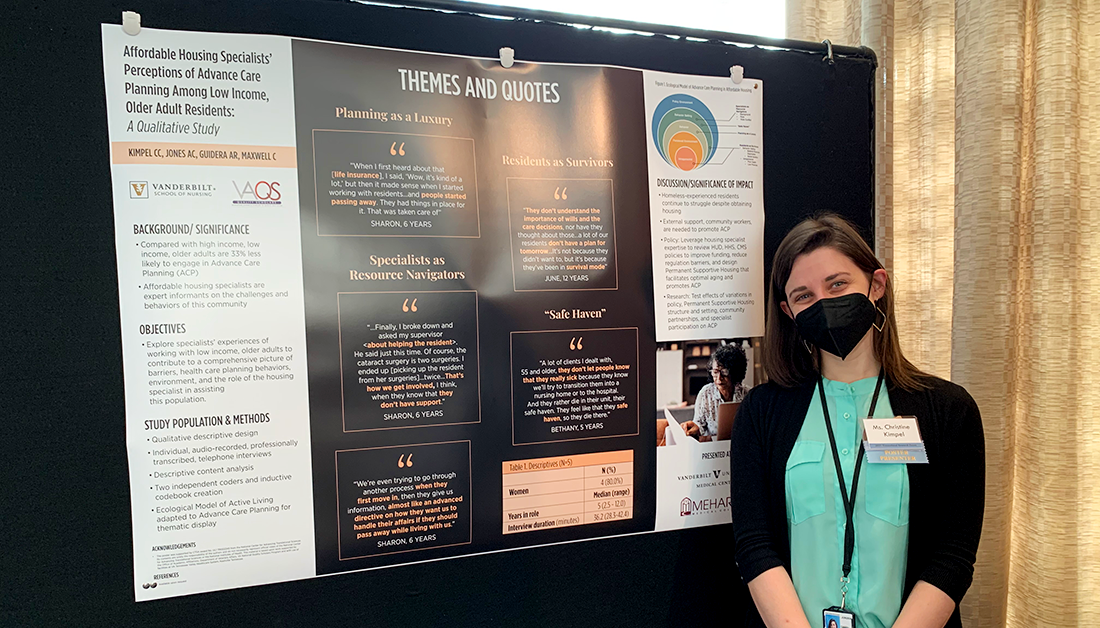
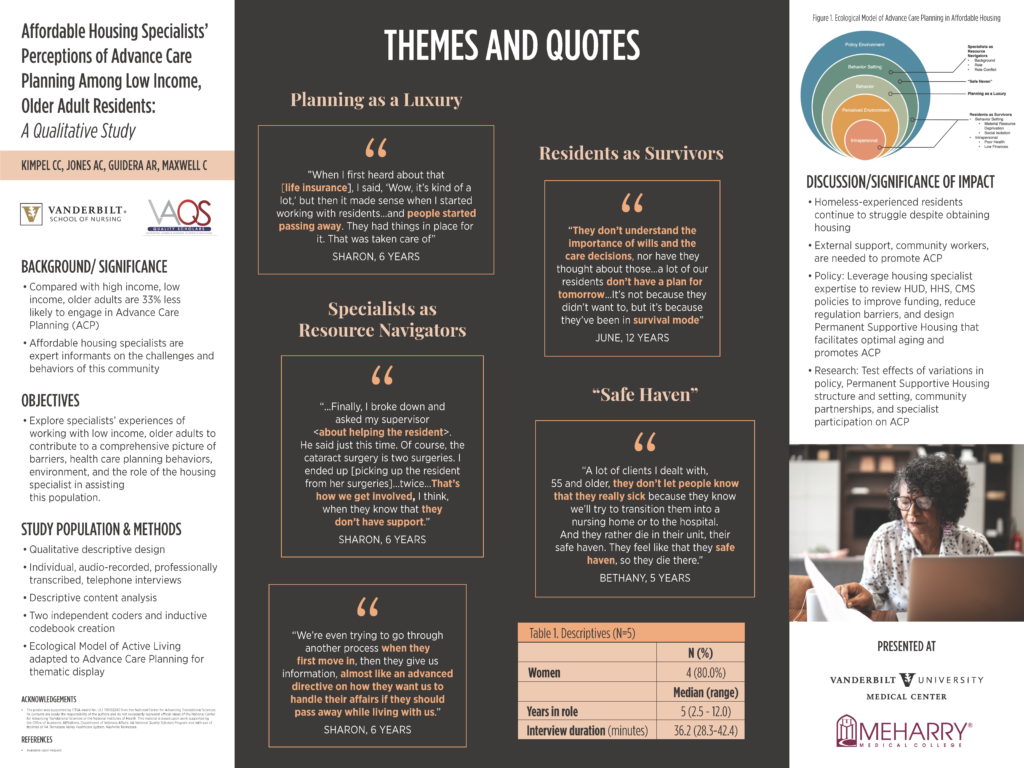
Christine Kimpel’s better poster design (image by Helen Bird)

That poster I noticed? The judges noticed it too and it won third place at Vanderbilt Translational Research Forum and a travel grant to Translational Science 2022.

I reached out to Christine Kimpel BSN, RN, MA, PhD(c), whose poster inspired me, and Caroline Taylor, Sr. Graphic Design/Multimedia Specialist for Vanderbilt University School of Nursing, who collaborated on the design of Christine’s poster, to share their insights with Edge for Scholars.

.

11 Quick Design Tips to Instantly Improve Your Poster

  1. Write clearly and concisely.
  2. Use bullet points and numbered lists to break up full sentences and paragraphs.
  3. Make each section shorter than a paragraph.
  4. Avoid big words in your title.
  5. Choose a sans serif font.
  6. Use the same font for the titles and body text. Make title font bigger and bolder.
  7. Format titles the same. Format body text the same.
  8. Left align text.
  9. Use 3 colors or less. Choose one of these colors to be the main color.
  10. Add images to break up a text heavy poster.
  11. Ask a colleague in a different field to give feedback.

.

Better Poster Design

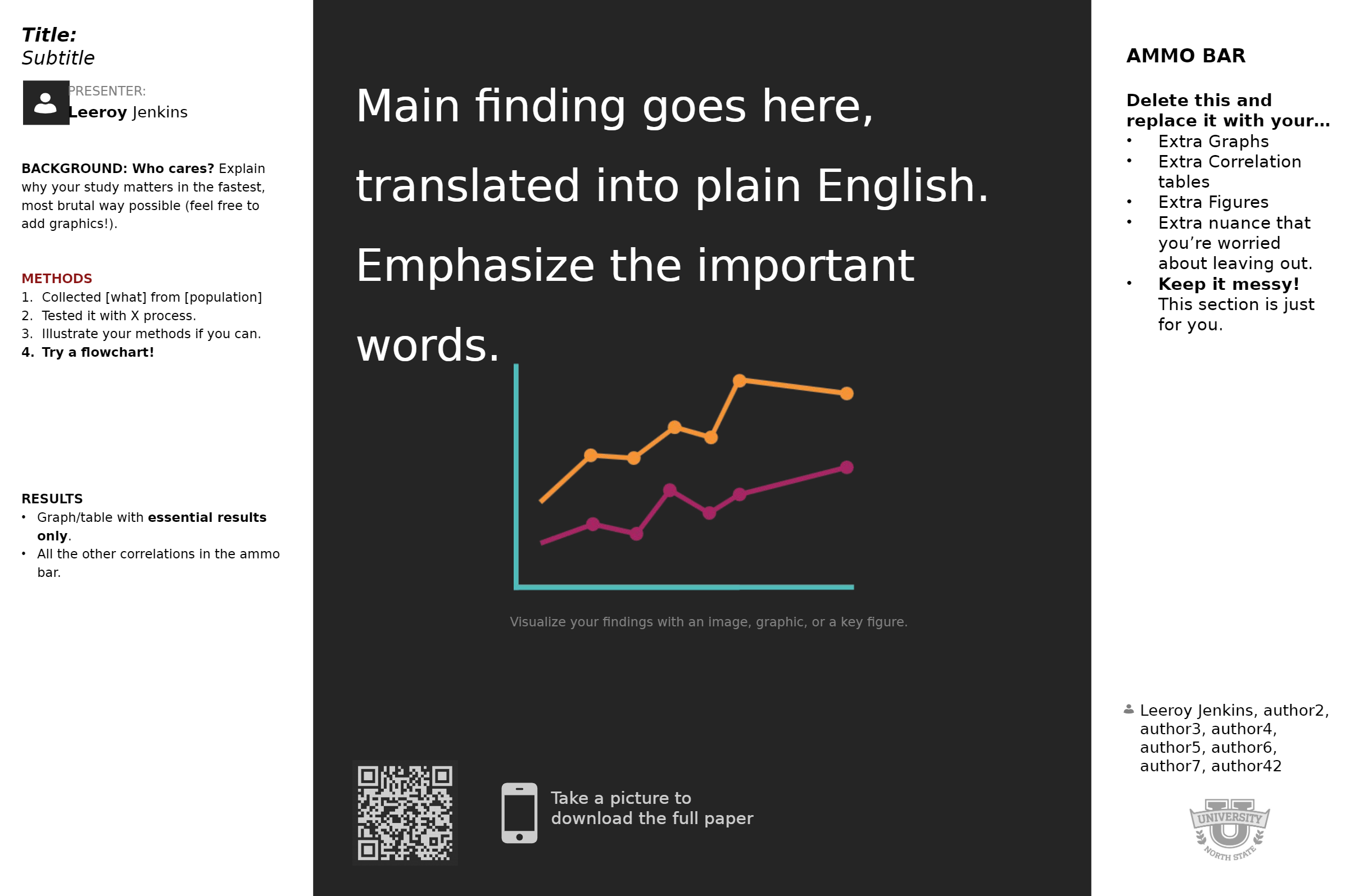
The Better Poster is designed to maximize insight, encourage conversation, and make it easy to quickly understand the research.

Better Poster Template (image by Mike Morrison)

The main finding, or key takeaway, is written in plain language and placed front and center. It is 12-15 words and easily read from 10 feet away. On the left is an overview of the study and to the right are the findings. A QR code links to more information.

Mike Morrison designed the new poster format and encourages presenters to adapt the template for their own needs, while keeping the poster clean, concise, and easy to read.

.

Newbie Strategies for Starting a Poster

  • Start 3-4 months before you need to print the poster.
  • Check the conference guidelines for required poster sections and size.
  • Know the resources at your institution (graphic design, poster printing, etc.) and contact early.
  • Work on the text a little bit and then leave it for a few days to get perspective.
  • The results and discussion sections take the most time and thought.
  • Posters are not read from start to finish. Each element should be understandable in any order.
  • Discuss the best way to show results with your research team.
  • Give your research team 2 weeks to review the poster. A call is helpful to hammer out the details.
  • Be mindful of time and how long it takes to print the poster.

.

Steps for Creating a Poster in PowerPoint

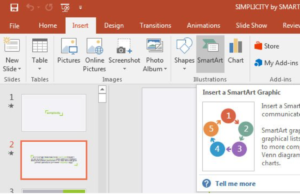
Use PowerPoint Designer and SmartArt to convert text to graphics, icons, and charts. (image)

  • Write the text first.
  • Change the PowerPoint slide to the actual size of the poster.
  • Use separate text boxes for each section. Left align text.
  • Copy the text info into the poster. Does it look chaotic?
  • Eliminate unnecessary words and cut the text down until it will easily fit on the slide.
  • Use bullet points to break up paragraphs and create space.
  • Zoom to 100% in PowerPoint. If you can’t read the text, your audience won’t be able to either.
  • Use PowerPoint Designer and SmartArt to convert text to graphics, icons, and charts.
  • Design your poster on a main slide, but have other slides open to work on different elements.
  • Put image credit directly under image, even if you use a free site.

.

Resources

Research Poster Best Practices

Better Poster Templates

Create a Better Research Poster

#betterposter

Select a Color Theme

Copyright Free Images (Unsplash is an Edge for Scholars favorite)

Free Icons

Free QR Code Generator

Poster Accessibility for People with Disabilities

.

Books

Better Posters: Plan, Design and Present an Academic Poster by Zen Faulkes

Effective Data Visualization: The Right Chart for the Right Data by Stephanie Evergreen

The Wall Street Journal Guide to Information Graphics: The Dos and Don’ts of Presenting Data, Facts, and Figures by Dona Wong

.

Thank you to Christine Kimpel and Caroline Taylor for sharing their expert knowledge with Edge for Scholars.

Christine Kimpel is a Registered Nurse, a PhD Candidate at the Vanderbilt University School of Nursing, and a first year Fellow in the VA Quality Scholars Program. Her clinical experiences with Palliative Care spurred her interest to explore determinants of Advance Care Planning. She earned her BSN (cum laude) and MA degrees from Kent State University. Her dissertation research focuses on identifying Age-Friendly Environment factors of Advance Care Planning among low-income, older adults. She plans to develop this program of research around the use of community-based participatory research approaches to reduce Advance Care Planning and Palliative Care inequities. Christine serves on the board of the Middle Tennessee Chapter of the Hospice and Palliative Nurses Association. Additionally, she is a member of the Iota at-Large chapter of Sigma Theta Tau and the Tennessee Nurses Association. At the VA, she is collaborating on the deployment of a quality metrics dashboard.

Caroline Taylor is a Sr. Graphic Designer / Multimedia Specialist for Vanderbilt University School of Nursing. There, she specializes in creating visual marketing objectives that best benefit the school, as well as faculty and staff. Her research poster designs have been featured by VUSN’s faculty, winning nationally ranked awards.

Christine Kimpel BSN, RN, MA, PhD(c) won third place at Vanderbilt Translational Research Forum.


Further Reading from Edge for Scholars

Best Poster Resources for Trainees

The Newbie’s Excellent Infographic Adventure

PowerPoint Hacks for Scientific Poster Design

Making a Better Research Poster

Networking for People Who Hate Networking: A Field Guide for Introverts, the Overwhelmed, and the Underconnected

Not that Kind of Conference: Attending Clinical Conferences as a PhD

Doing Research

For a number of years, I attended one or two conferences annually, focused on my Terrible Disease of Interest, but at meetings largely composed of PhDs like me. More recently, I have started attending the clinical meeting relevant to the MDs who treat said Terrible Disease. The meeting is large and most of it is not directed towards me, however, I am here to tell you why I go and why you should consider attending. N=mostly me, with a few observations of more established investigators.

Be an active member of your clinical Department: While your chair and clinical colleagues will not know your smaller, basic science meeting, they all know the large clinical one. In fact, the entire department is likely going, and as a member of the department, postdoc or faculty, you should be there too. It is also a nice opportunity for your chair to show off the research in the Department, and a chance for you to connect with other chairs who support similar research programs, as well as meet the PhDs in those departments. If you are a postdoc, these research-intensive departments are likely to be hiring. It is never too soon to start making connections with your future chair. If you are a member of a basic science department, attending these clinical conferences becomes even more important, as you want to be a known entity, particularly if you are developing a translational research program.

Learn emerging trends and treatments: A large part of our job as translational scientists is selling the importance of our science. This means not only understanding the problem, but also understanding the clinical treatment of said problem. There is often a lag time between a seminal clinical trial and adoption of the practice into the clinic. If you rely on the literature for keeping up to date with the latest treatment guidelines, you can miss important changes in care or controversies. I was recently surprised at a clinical meeting to discover something I believed to be widely accepted and of concern was actually wildly controversial in clinical practice. Needless to say, there were some re-writes on that section of the grant. It did not change the science or the preliminary data, but it did impact why the problem was significant and why our approach was innovative.

Find your community and build your network: Being a scientist on the edge of basic and translational research can be isolating. The clinicians think you do basic research and the basic researchers think your studies are clinical. Large clinical meetings will have a basic science component, and there you will meet the graduate students, postdocs, and principal investigators (PIs) that work in the field. This is your community—get to know them. The PIs you meet will likely review your papers and grants, and it is good for them to know you and your work. This is also the easiest time to network (tips for networking). Everyone is looking for someone to talk to during the poster session, so go meet some fellow scientists. If you are a postdoc, tell people to come check out your poster.

Identify collaborators and mentors: In the research portion of these meetings, you will identify the clinicians that are interested in a research program. These are the clinical faculty you, as a new PI or postdoc, want to meet. Clinical collaborators and mentors provide access to knowledge and resources (clinical samples, patients, data, etc.) that you normally cannot access. They are invaluable to leading a translational science program and can lead to some interesting projects and collaborative grants. Moreover, by examining their research programs, you can identify areas of potential collaboration or learn how they successfully interact with their PhD counterparts, be they in biostats, molecular biology, or epidemiology.

The reverse is also true for clinician-scientists: If you are a clinician-scientist interested in building a basic science program, come to our conferences too. You too will build your network, identify mentors, learn where the field is heading, and most importantly, spend a couple days hanging out with people who like the same science you do! We promise not to ask you how your science will cure our Terrible Disease of Interest.

In summary, if you get a chance to go to the big clinical meeting in your field, go. You will make some new contacts and appreciate the clinical complexity of the disease which you study. If nothing else, you will get some free swag and meet some new friends.

Did I miss an important point? Do you have questions or concerns about the post? Or perhaps an anecdote to contribute! Feel free to send some electrons my way in the comments, via Twitter @PipetteProtag, or through traditional electronic mail pipette.protagonist@gmail.com

More Resources

Spring Conference Season Essentials
Connecting on Twitter During Conference Season
Pro Tips for Networking and Collaborating
It’s National Science Meeting Time! Nine Protips on Meeting, Greeting, and Getting It Done Like a Rockstar


More Friendly Advice: When Rejection Isn’t Really Rejection

Doing Research / Grants & Funding

When rejection isn’t really rejection – more friendly advice from your NIH grant reviewer

I know you’ve heard it, too – “Not Discussed” means you should toss that idea in the black hole of bad research ideas never to be spoken of again. But how many clever, impactful, innovative ideas start out that way?  Of course, some people are born beautiful, but we all know the story of the ugly duckling.

Sometimes, there are moderate to major weaknesses in the research or training AS PROPOSED. This may be serious enough to push it to the bottom half of the group resulting in the dreaded “Not Discussed.” But it does not necessarily mean that the idea cannot be modified into an exciting and fundable project.

You have developed and nurtured this project this far. So take a deep breath and read the critiques carefully and with an open mind. You may be surprised that the concerns are addressable – and may even improve the research! Study the reported strengths, as well as the weaknesses. If anyone can sculpt this into a better project, it is you. Consider that the response might be a resubmission, or a new submission that is a better spin off of the present one.

So remember that sometimes rejection is really just an invitation to create a better proposal. But, even if you decide that this proposal really is better sent to the black hole, then learn from it and let it go – on your terms.

More Resources

Rejection and Resiliency Roundup

Dealing with Rejection

Responding to Manuscript Reviews While Avoiding Cerebral Aneurysms