Finally! Data on What Study Section Really Cares About

Grants & Funding

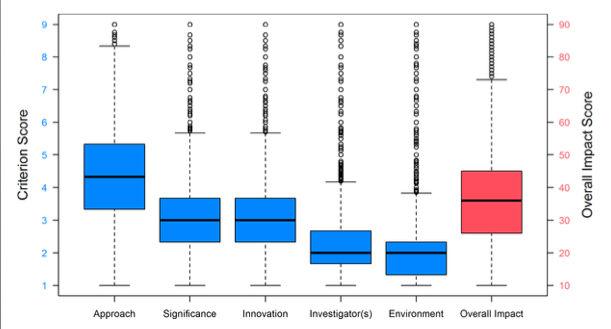
In 2009, NIH revamped their scoring system asking reviewers to provide numbers ranging from 1 (best) to 9 (worst) assessing applications Environment, Investigator, Innovation, Approach, and Significance.
highlight-significanceNIH has emphasized Innovation (insert jazz hands), leaving many a weary grant writer to feel a need to invent fabulous new techniques to take DNA out of things, put it back in, and take it back out another time to reassure study sections that the gene you are studying does the thing you thought it would. And if you can do that in a nano platform with a high throughput screen, all the better.
It takes only a brief gander at NIH’s instructions to authors to reinforce the need for extra technological bedazzlement. It’s right there in big letters.

“Highlight Significance and Innovation”

It turns out that strategy may not be all it’s cracked up to be. PLoS One published a study by Eblen et al. evaluated over 70,000 applications looking at what metrics best-predicted funding success. Innovation and Significance were NOT the winners. Approach was.
impact-score

Yes, that entirely unglamorous doing a project the right way, asking smart questions, and using robust design correlated far better with success than other metrics.

Several questions leap to mind including. Why didn’t NIH do this analysis earlier? It seems that they’ve been directing folks to the wrong area to emphasize. Either that or study sections are going rogue. And, here’s a vexing one, are we so precious that we all have to get 1’s, 2’s and 3’s for Investigators and Institutions? I don’t love statistics, but if everyone scores above average, doesn’t that mean we are all average or the space-time continuum is going to implode or something?

Read the paper. It’s pretty impressive and an excellent reason to slow down, think harder and make sure your study section is clear that not only is your question timely and relevant, but that you are doing it in a thoughtful and thorough manner.

Figure from PLoS One How Criterion Scores Predict the Overall Impact Score and Funding Outcomes for National Institutes of Health Peer-Reviewed Applications Matthew K. Eblen, Robin M. Wagner, Deepshikha RoyChowdhury, Katherine C. Patel, Katrina Pearson

 

Three (Grant) Peeves in a Pod: Formatting

Grants & Funding

Ever since the holy trinity important things have come in threes—listen up. Every study section I have been in for years includes the complaint that certain grant authors:

1.) Cheat the font sizes in their tables and figures.

Don’t make me adjust my bifocals. It makes me cranky.

2.) Have inconsistent, sloppy, incorrect, or incomplete references.

If you can’t create a clean bibliography or biosketch, why should I trust you to create precision data?

3.) Use color schemes that don’t convert to black and white.

Yes, I’m a dinosaur; I’m going to read your grant on paper.

Don’t skimp on any aspect of formatting your proposal. Even if I am only subconsciously peeved it can hurt your grant score…and only nearly perfect scores clear the payline.

Diversifying Your Research Portfolio

Grants & Funding

Today the Newman Society held a panel discussion with three independent investigators who recently received their first large non-NIH grants.  Their tips for diversifying your research portfolio are:

Finding Opportunities and Repurposing Ideas
Dr. Natasha Halasa
CDC Funding

  1. Look for announcements and RFAs at all of these websites:
    • gov
    • CDC
    • AHRQ
    • PCORI
    • Foundations
    • Societies
    • Drug companies (investigator-initiated grants)
  1. When at meetings, go to the drug company booths and ask about grants.
  2. Network within Vanderbilt; lots of people here have non-NIH funding.
  3. Apply to different agencies with the same idea—you’re running a business and don’t want to always have the same customer.
  4. Keep a running list of ideas and specific aims to pitch.
  5. Every little grant will lead to something bigger.
  6. Negotiating startup funds allows you to do a pilot project without having to get a grant.
  7. Spend your startup money!
  8. Take advantage of having protected time on a K award: Show you can get little jobs like pilot funding, small awards, and small papers done before going for the big grant.

Put Your Best Foot Forward
Dr. Aron Parekh
American Cancer Society Funding

  1. Submit your best writing and science, as you would to NIH. (Success rates for private sources of funding can be similar or have even lower success rates than NIH such as the American Cancer Society since they are receiving so many more applications now.)
  2. But make sure your science is in the sweet spot for the foundation and is compatible with what they’ve funded before.
  3. Don’t let the hunt for foundation funding drag you away from your primary intent.
  4. The ACS Research Scholar grant provides four years of funding at $165k/year with 20% indirects.
  5. It’s structured like an R01 with 1 page of specific aims and 12 pages for research strategy.
  6. They allow detailed methods in an appendix, which frees up space in the main body.
  7. You must complete a section for why your idea is suited to ACS and cancer.
  8. There are two deadlines per year.
  9. You have to be within six years of your first appointment as an independent researcher.
  10. This award can be held at the same time as an R01-type award.

Demystifying the VA
Dr. Christianne Roumie
VA Funding

  1. There are 4 main funding sections and study sections within each of them. As with all funding agencies know the right place to send your application.
  2. A Merit or Investigator Initiated Research (IIR) award is an R01 equivalent
  3. You can’t be the PI on more than one Merit concurrently unless there are two different parent grants.
  4. Your research strategy is 14 pages.
  5. The committee looks to see that you have VA experience and a commitment to improving veteran health .
  6. Work with people who understand the VA budget:
    • Clinicians cannot request salary support because your salary as a clinician is covered through medical center funds—ask for eighths.
    • For a Merit, it’s better to have 1-2 eighths when you apply, and you can ask for up to three to be the PI on a grant.
    • PhDs and MDs should contact Drs. Robert Dittus, Don Rubin and Brian Christman to get in the eighths pipeline; or contact the service chief of your specialty at the VA.
    • For a VA K, you have to submit a letter from VA HR saying you’re eligible to be hired along with your application.
  7. VA funded research must be performed within the VA facility. If your work or lab is off site (i.e., Vanderbilt) get the off-site waiver early as part of your application.
  8. Certain study sections for a Merit (Epidemiology and Clinical Trials) and all Career Development awards require a LOI. This deadline is typically 3 months before the grant deadline.
  9. There are only two funding cycles per year: Fall and spring for clinical and basic science, winter and summer for health services.
  10. READ THE DIRECTIONS FOR THE VA–SF424!