 Dr. Doug Johnson is the Associate Director for Translational Research at the Vanderbilt-Ingram Cancer Center (VICC) and Professor of Medicine in the Division of Hematology/Oncology. He has a strong track record in partnering with industry to conduct research projects and clinical trials. He shared some helpful insights for early career researchers seeking to partner with industry.
What advice do you give to your mentees seeking industry funding?
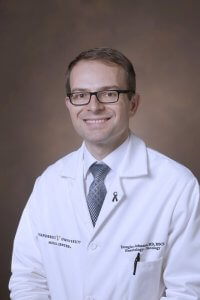 DJ: One key piece of advice my mentor, Jeffrey Sosman, M.D., passed on to me was that if you build it, they will come. My mentor and Mark Kelley, M.D. started a melanoma biobank and I helped build it up further and developed a well-annotated clinical specimen and data bank. We’ve built something really attractive to collaborators across both academia and industry, because, in many cases, access to biospecimens and clinical data is one of the rate-limiting steps.
Willingness to engage with industry is another key to building successful partnerships. Researchers don’t have to be indiscriminate and talk to everyone, but they should welcome conversations to learn how much and what type of support companies have to offer them. Increasing experience with meeting people and engaging in dialogue can help researchers work through processes and details quicker to determine if a partnership will work.
Consider win-win opportunities. The opportunity should be useful for all constituents (patients being the number one focus, but also the donor and the researcher). Undoubtedly, the potential industry partner will assess the benefits to their business. Scientists should move forward with eyes wide open, knowing they have a valuable resource, and any potential partnership needs to be mutually beneficial, useful for patients and for their own career.
Understanding inputs and outputs should be part of the process. For example, looking at input/output— will the researcher exhaust their repository to get one low-impact paper? Or, on the other hand, will they get to use cool, cutting-edge technology that will give them incredible data that leads to publications and grants, and is useful in other ways? Those are two different scenarios. I encourage my mentees to think about their discussions with potential partners to determine if it’s reasonable and makes sense for them to continue the conversation.
It’s important for researchers to consider exactly what they will get from the collaboration, because there are some industry collaborators who will extract as much as the scientist is willing to give them. Not in a nefarious way. The company might be focused on its own interests. Researchers should protect their own interests by fully leveraging their resources and making sure the relationship aligns with their research goals.
Beforehand, learn how the process works. If the scientist provides samples, will the company give the data back so the scientist can look at the results? Or will the company analyze the data themselves? Will the collaboration lead to a joint publication? Clarifying things like cost and who will pay for what are also important factors. Sort out specifics early in the process to assess fit and avoid unfortunate discoveries six months into the contracting process. Thankfully, here at Vanderbilt, we have a great contracts management office, VUMC Office of Sponsored Programs-Contracts Management, and the Center for Technology Transfer and Commercialization to help guide and manage such processes.
Failing to build a partnership isn’t a bad thing. Potential partnerships might fail for various reasons—misaligned legal requirements, unbalanced or incongruent objectives among constituents, and even differences in methods (analytically or how biospecimens/samples are handled). The goal is to ‘fail fast’ to avoid devoting too much time and effort to an untenable partnership.
Not all partnerships with industry result in large funding opportunities, but they might still be worth pursuing. If a company is interested in a particular biomarker or has a new sequencing assay or some kind of AI signature that they’re interested in, a scientist with samples or clinical data might benefit from collaborating with that company. Typically, those opportunities are more useful for getting papers published and building name recognition than they are for providing significant career funding. The company might cover the cost to do the assays and not offer anything more substantial. That should not be a deterrent to collaborating with them. Joint, high-impact papers might be the only immediate reward, but the work could later result in funding from the same company or from a referral. In the cancer world, a common mechanism is to function as a sub-investigator within an industry-sponsored clinical trial. These types of opportunities exist across other disciplines and with translational research too.
Where can scientists meet potential industry partners or find investors?
DJ: Mentors can function as conduits to new relationships through their network. My mentor introduced me to different people and facilitated my authorship of papers. I met a number of people that way, including a scientist working on immunotherapy, which led to a clinical trial examining the effects of the PD-1 inhibitor.
Being able to leverage a mentor’s connections can be instrumental in launching the careers of researchers who are just getting started. I was fortunate to have a mentor who allowed me to do that, so now I do the same for my mentees. It becomes a virtuous cycle when you experience success using this strategy. Other scientists witness your methods and not only try to emulate the pattern, but seek to collaborate with you.
National and local professional meetings can serve as a gateway. Speaking for oncology, the American Society of Clinical Oncology meetings are well attended by industry, which provides many opportunities for professionals in the oncology field to build relationships with industry contacts. Medical science liaisons or other people who are influential within the research division of a company are also good sources. Willingness to interact with those individuals, remaining open to hearing what they have to say, can produce unexpected rewards. Be patient. I would say the success rate for landing a partnership (relative to the number of initial conversations I’ve had) is probably around 10 or 20 percent.
Occasional opportunities for industry grants are possible, though more an exception than the rule. Most of my dealings with industry have been an in-kind collaboration where we provided the samples, they provided the sequencing, and then they gave the data back to us and we could do whatever we wanted to with the data.
Patient philanthropy can sometimes be a surprising source. I would encourage scientists to talk about their research with patients. Most patients don’t have an appetite for hearing about your research but describing your work in a clear and passionate way to the few that do want to listen potentially allows them to catch the vision and could get them excited about funding your project.
Cultivate connections with leadership and clinical partners. This is especially important for scientists who don’t work in a clinical setting (PhDs). Leadership has ties to philanthropic sources and may think about a particular scientist more readily when an opportunity surfaces, especially if the scientist is excited about their research and is highly productive. If it makes sense for a PhD scientist to collaborate with a clinician who might be less interested in research or who doesn’t have a big research program, they can leverage their expertise to gain traction for the project with key constituents. The goal as a researcher should be to cast a wider net which can provide a bridge that connects them to people in not only in academia, but also those in industry and at other philanthropic organizations.
Douglas Johnson, MD, is an oncology researcher exploring ways to profile cancers to predict which patients will benefit from immune therapies and has published numerous papers in this area. He is also focused on understanding the effectiveness and toxicities of immune therapies in high-risk patients, including those with autoimmune disorders, advanced age, or organ dysfunction. Dr. Johnson is the lead investigator on numerous clinical trials at Vanderbilt.
